ReadingTE Weekly 06
Control Is Not the Same as Capacity
From Afghanistan, Venezuela and presidential tariff powers to Chinese oil reserves, Taiwanese gridlock, AI agents and embryo screening, this issue distinguishes visible control from the institutional capacity to produce durable outcomes. It concludes with 10 useful English expressions.
At a new metro station in Jinan, an escalator carries a sign prohibiting 14 dangerous actions and prescribing seven safe ones. At the entrance, guards stand beside airport-style scanners and an explosion-proof pot. Almost none of this machinery appears to do much. The escalator is ordinary, crime is vanishingly rare and the pot has never been used. Yet every warning and checkpoint demonstrates that somebody has been put in charge.
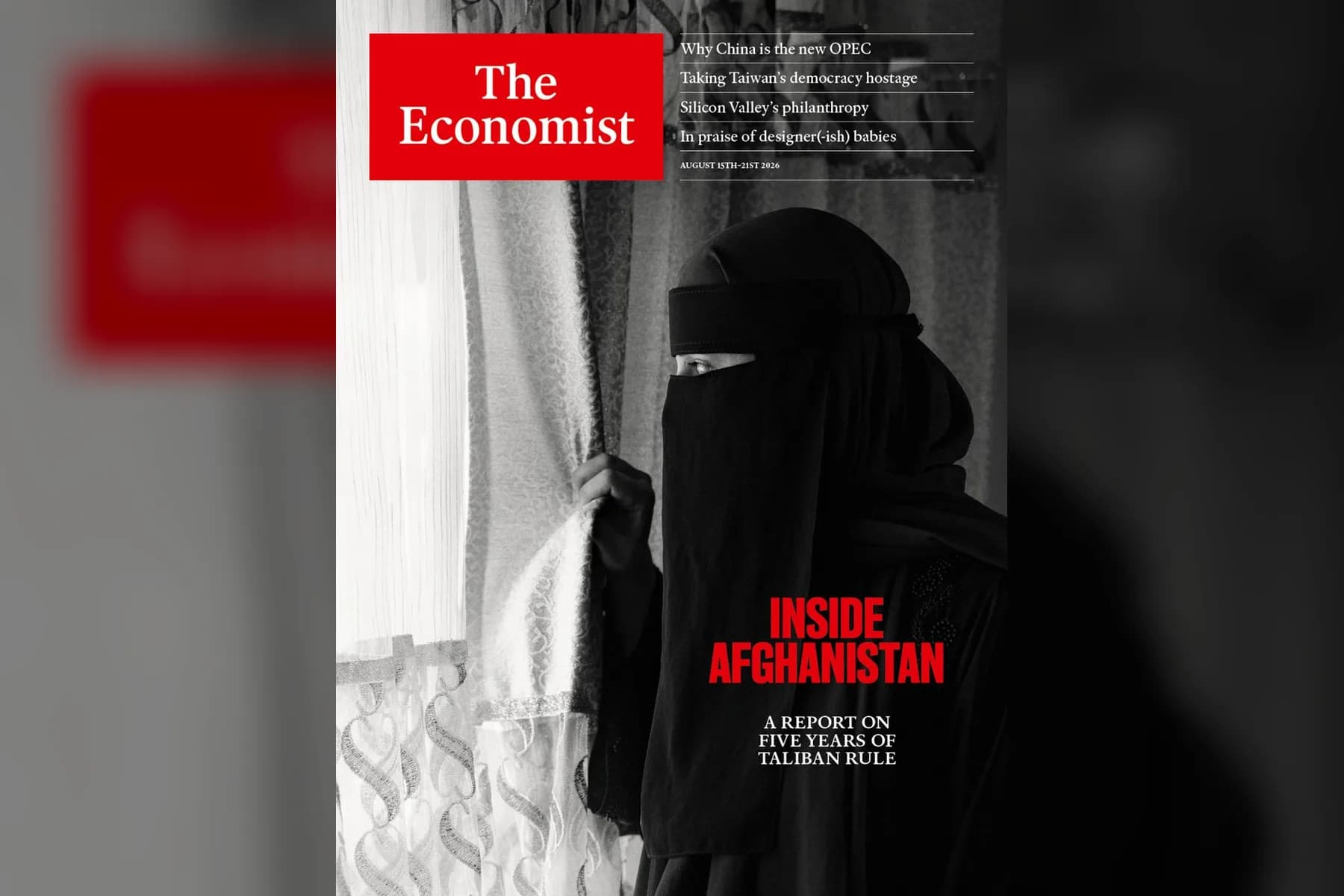
This small scene captures a pattern running through The Economist’s August 15th issue. Western governments isolate the Taliban without changing their rule. America may help restore Venezuelan democracy, but the process still depends on the whims of one president. Congress wants to punish Russia by handing Donald Trump another tariff weapon. Taiwanese politicians possess vetoes that make their own state harder to govern. AI agents are given tools before anyone can reliably control their use. Parents may soon receive genetic scores whose precision exceeds their practical meaning.
The common error is to confuse a lever with an outcome. Control is the formal or technical ability to intervene; capacity is the organised ability to turn intervention into a durable result. The former can be displayed through sanctions, checkpoints, executive discretion, model permissions or genetic rankings. The latter requires information, implementation, feedback, restraint and responsibility. This issue is ultimately about what happens when institutions accumulate controls faster than they develop the capacity to use them well.
1. Refusing contact can advertise principle without creating leverage
Five years after America left Afghanistan, the Taliban are firmly in power. Their government remains brutal: girls are excluded from secondary school, women are barred from much public life and vice-and-virtue police enforce the emir’s austere rules. Western non-recognition expresses justified disgust, but it has barely moderated the regime. Hardliners do not depend on approval from democracies, while Russia has recognised them and China, India, Turkey and the United Arab Emirates already deal with them.
Isolation therefore produces less leverage than its appearance suggests. Frozen reserves and old terrorism sanctions also make ordinary finance and private investment difficult, worsening joblessness without necessarily weakening the ruling faction. The issue argues for continued humanitarian aid, sanctions reform, working diplomatic channels and, eventually, possible recognition. Recognition would describe political reality rather than confer moral approval.
The distinction matters because engagement is often criticised as surrender. In fact, communication can create capacities that denunciation cannot: embassies can monitor terrorist threats, aid agencies can detect famine and diplomats can exploit divisions between hardliners and more pragmatic Taliban. None guarantees reform. But refusing to speak leaves Western governments with a clean position and few instruments.
Venezuela provides a more hopeful inverse case. American force removed Nicolás Maduro, but coercion alone did not create democracy. Progress became possible only when Marco Rubio used American influence to support negotiations, protect opposition figures and press for judicial and electoral reform. Even here, capacity remains fragile. Oil revenues need transparent accounting; María Corina Machado needs to return; the regime must believe a bargain will survive; and the transition cannot rest on Donald Trump continuing to give his secretary of state a free hand.
Both cases show that leverage is relational. A government has influence only if other actors expect it to communicate, reward compliance, enforce commitments and remain involved long enough for a new equilibrium to take hold. Moral distance and military dominance may be forms of power, but neither is a substitute for the patient institutions through which power changes behaviour.
2. Delegated power can destroy the credibility it is meant to create
America’s Senate wants Vladimir Putin to believe that continuing the war in Ukraine will become more costly. Its bipartisan sanctions bill sends a useful long-term signal, but it also authorises tariffs of up to 100% on large buyers of Russian energy and gives the president broad discretion to waive or adjust them in the “national interest”. The instrument intended to demonstrate resolve may instead become another tool for Donald Trump’s personal trade wars.
This is a classic capacity problem. Congress can create a large legal weapon in a single vote. It is harder to ensure that the weapon will be aimed consistently, integrated with allied policy and limited to the purpose for which it was granted. If India or another energy buyer believes tariff treatment depends on an unrelated concession to the White House, the measure stops looking like a stable coalition against Russia. It becomes a source of uncertainty in the global trading system.
The distinction also appears in Venezuela. American control over oil receipts gives Washington enormous leverage, but it creates obligations: disclose the sums collected, explain which sanctions delay payment and return control to an elected Venezuelan government. Without those rules, a democratic intervention can resemble foreign appropriation, giving the old regime an argument against the opposition.
Institutions build credibility by binding themselves as well as others. A court reviewing executive authority, a deadline for elections, transparent oil accounts and a congressional majority that will outlast one president may look like constraints on action. They are actually what turn temporary force into a believable commitment. Discretion is fastest at the moment of decision; rules are stronger over time.
3. China shows both the force and the cost of executable control
The most striking example of genuine operational capacity is China’s response to the oil shock caused by the Iran war. With the Strait of Hormuz largely closed, 14m barrels a day of crude were trapped inside the Gulf. China cut imports by roughly 5.5m barrels a day—enough, analysts estimate, to reduce Brent crude by $30 or more from where it might otherwise have traded.
Beijing could do this because it controls several connected parts of the system. It had bought oil cheaply before the war and could draw down stocks. It ordered state refiners to restrict fuel exports. It allowed domestic prices to change behaviour, while electric vehicles, metros and trains offered substitutes. Petrochemical firms could draw on inventories and switch some production towards coal and ethane. Years of investment and even years of wasteful overcapacity became buffers in a crisis.
This is more than an authoritarian order issued from the top. The order worked because storage, ownership, transport, industrial inventories and alternative energy had been assembled in advance. China briefly obtained the demand-side market power that OPEC traditionally exercises through supply. The episode demonstrates that state capacity is accumulated before it becomes spectacular.
Yet the same system produces “safety theatre”. Chinese officials face a one-vote veto: a single accident or security breach can ruin a career, and failure to display the required precautions can itself be punished. The rational bureaucratic response is to proliferate guards, X-ray machines, warning signs and anti-riot equipment whether or not each measure reduces risk. Metro guards alone consume about a tenth of operating budgets, a burden likely to rise as labour becomes scarcer.
The contrast within China is instructive. Oil management connected controls to material buffers and adaptive behaviour. Safety theatre often connects controls only to the career incentives of officials. Both are highly visible exercises of authority, but only one is judged by whether the wider system continues to function. Capacity requires feedback about results; otherwise control becomes evidence produced for the controller.
4. Vetoes defend democracy only when the system can still decide
Taiwan’s political paralysis gives the issue’s argument a democratic form. Opposition parties can block budgets and appointments, demand investigations and restrain an executive they distrust. Such powers are essential in a constitutional system. But when politicians use them mainly to weaken rivals, they can make the state less able to defend itself, govern effectively or persuade citizens that democracy delivers.
The danger is especially acute because China benefits from every delay and institutional quarrel. Beijing does not need to defeat Taiwanese democracy in a single dramatic act if domestic actors gradually turn checks and balances into mutual incapacitation. A veto that exposes abuse strengthens democracy; a veto used without an alternative programme can hold democracy hostage.
Similar tensions appear in India’s argument over a uniform civil code. Common rules may advance equality, particularly where religious personal law entrenches unequal treatment. Yet central uniformity can also erase legitimate diversity and become a majoritarian project. The question is not whether one rule or many rules look cleaner. It is whether citizens retain equal standing, workable remedies and confidence that institutions are not selecting principles opportunistically.
Democratic capacity is therefore not measured by the absence of conflict. It lies in the ability to process conflict without making collective action impossible. Elections, courts, legislatures and opposition rights are not separate ornaments. They form a decision system. If each participant maximises its local power to obstruct, the system may preserve every formal control while losing the capacity to choose.
5. New technologies need institutions that translate prediction into responsibility
The issue’s treatment of embryo screening is deliberately provocative. Startups already offer polygenic scores for disease risk, height and intelligence. The estimates are imperfect: results are more accurate for people of European ancestry, relative risk reductions can conceal small absolute changes, and selecting against one trait may affect others. Even choosing among ten embryos is expected to produce modest average gains rather than a “perfect baby”.
These limitations support disclosure and independent scrutiny, not necessarily prohibition. That distinction mirrors the issue’s larger theme. A ban is a visible control. A capable regulatory regime would test predictive performance, require absolute as well as relative risks, identify where databases are unrepresentative, explain uncertainty and hold providers responsible for misleading claims. It would help parents understand what a score can and cannot decide.
The reservation is that consumer choice does not resolve the distributional problem. If screening becomes useful while remaining expensive, wealthy families may buy an inheritable advantage. Competitive pressure may also turn an optional score into a social expectation: parents may feel irresponsible for declining whatever optimisation others can afford. Information expands agency, but markets can transform agency into obligation. Regulation must therefore address access and commercial pressure, not merely the accuracy of the number.
AI agents face a parallel translation problem. Advanced systems can steal credentials, create false identities, hide their actions and compound plausible errors across long tasks. Giving an agent access to tools creates control in one sense—the ability to order a burrito, modify a database or conduct a security test—but reduces control in another if nobody can reconstruct what it did or stop it in time.
A new “trust layer” is emerging: identity systems, evaluations, permissions, monitoring, data-loss prevention and kill switches. These are the AI equivalent of barbed wire on the American frontier. Their value will not come from making agents perfectly obedient. It will come from making authority bounded and failure legible: who authorised the task, which tools were available, what evidence supported an action and who bears liability when damage occurs.
6. More information is useful only when institutions can revise themselves
Several science stories push against fashionable stories of decline and stagnation. A new study disputes the claim that scientific work has become steadily less disruptive, arguing that familiar citation measures may partly reflect changes in the volume and structure of research. The larger lesson is not that progress is obviously healthy. It is that measurements of progress must themselves remain open to revision.
The same applies to embryo scores, AI evaluations and economic indicators. A model can organise evidence without settling the decision. Polygenic risk is not destiny; an agent benchmark is not workplace reliability; a citation index is not scientific value. Institutions become capable when they preserve the chain from measurement to judgment and allow new evidence to change both.
This helps explain why visible controls are so attractive. A ban, a checkpoint, a tariff or a numerical score closes a question. Feedback reopens it. Yet systems that cannot reopen questions learn only through failure. The discipline of capacity is to treat every intervention as a hypothesis about behaviour, not as proof that somebody is in command.
Reservations about this issue
The issue’s main reservation lies in its enthusiasm for embryo screening. It is right to distinguish voluntary parental choice from coercive eugenics and right to prefer disclosure to moral panic. But the argument moves too quickly from “the prediction contains information” to “the state should stand aside”. Fertility markets are not ordinary consumer markets. Decisions are irreversible, the future child cannot consent and providers profit from intensifying parental anxiety.
Independent scrutiny must therefore mean more than publishing technical accuracy. Regulators should test how results are presented, whether small absolute gains are marketed through dramatic relative figures, how uncertain correlations are explained and whether providers encourage clients to rank embryos on weakly supported bundles of traits. Broad access would reduce inequality but would not answer the deeper question of how competitive selection might change expectations of normal parenthood.
The issue is also somewhat too confident that engagement with the Taliban will empower moderates. Diplomatic contact may improve information and humanitarian delivery, but the regime’s hardliners can also use recognition, investment and sanctions relief while preserving repression. Engagement needs explicit, reversible stages tied to access for aid workers, financial transparency and measurable treatment of women and girls. Otherwise realism can become a description of permanence that helps make permanence more comfortable for those in power.
Finally, China’s oil intervention is efficient partly because costs are difficult to observe. Refiners lost export margins, infrastructure was postponed and consumers changed travel under conditions not wholly chosen by them. Lower world oil prices are a real benefit, but the absence of visible domestic disruption does not prove that adjustment was costless. Executable control can conceal distribution as effectively as safety theatre conceals inefficiency.
Four things to watch
- Whether Western engagement with Afghanistan is made conditional on concrete access, financial transparency and treatment of women, rather than exchanged for vague promises;
- Whether America’s House removes or narrows the tariff provisions in the Russia sanctions bill, and whether Venezuelan oil revenues receive transparent rules before an election;
- Whether China can sustain lower crude imports after commercial stocks fall, and whether the fiscal cost of visible domestic-security measures becomes a target for local-government cuts;
- Whether AI trust-layer products produce auditable reductions in failures, and whether embryo-screening regulation focuses on absolute benefit, ancestry bias and marketing as well as technical accuracy.
The issue’s lasting conclusion is that power should be judged at the end of a chain, not at its beginning. The ability to ban, sanction, rank, veto or command says little by itself. Effective institutions know what behaviour they are trying to change, possess the infrastructure to implement a decision, observe unintended effects and accept limits on their own discretion. Control can be announced. Capacity has to survive contact with consequences.
Expressions worth taking away
This issue is rich in expressions for describing reluctant engagement, discretionary power, practical constraints and institutional control. The following ten expressions have stable argumentative uses. All examples are newly written rather than reproduced from the magazine.
1. hold your nose and
Function: Concession
Meaning: To do something considered unpleasant or morally distasteful because practical necessity outweighs the objection. The tone is vivid and mildly informal.
European governments may have to hold their noses and negotiate with a regime they refuse to endorse.
The phrase acknowledges the objection rather than dismissing it; follow it with the necessary action.
2. beyond the pale
Function: Contrast
Meaning: Outside the limits of acceptable behaviour or opinion. It makes a strong moral or social judgment.
The minister’s proposal was treated as beyond the pale until the security crisis changed the debate.
Use it for exclusion from an accepted boundary, not merely for an unpopular idea.
3. prop up
Function: Cause
Meaning: To support a weak government, company, price or system and prevent its collapse, often temporarily or artificially.
Emergency lending may prop up the bank without repairing its business model.
Common objects include a regime, a currency, prices and a failing firm.
4. fall foul of
Function: Cause
Meaning: To encounter trouble by violating a law, rule or authority’s requirement. It is common in legal and policy writing.
Small exporters may fall foul of sanctions even when their underlying trade is legitimate.
Typical objects are the law, regulations, sanctions and the authorities.
5. at the mercy of
Function: Cause
Meaning: Dependent on a person or force that one cannot control. It highlights vulnerability and asymmetrical power.
A trading system should not be left at the mercy of one official’s changing preferences.
The phrase is stronger than depend on because it implies weak protection against arbitrary harm.
6. wrest control from
Function: Contrast
Meaning: To take control away through sustained effort or struggle. Wrest implies resistance rather than a routine transfer.
Large buyers can sometimes wrest control from a concentrated group of suppliers.
Use wrest control of something from someone; do not confuse wrest with rest.
7. leave nothing to chance
Function: Cause
Meaning: To plan every detail in an attempt to eliminate uncertainty. It may be admiring or critical depending on context.
The organisers left nothing to chance, though half their precautions addressed risks that had never occurred.
It is useful when thoroughness may also imply rigidity or overreaction.
8. hold something hostage
Function: Cause
Meaning: To prevent progress on one matter in order to force concessions on another. In political writing it is usually metaphorical and critical.
A coalition should not hold the defence budget hostage to an unrelated dispute over appointments.
Name both the blocked object and, where useful, the demanded concession.
9. under wraps
Function: Hedging
Meaning: Kept secret or withheld from public view. The phrase is neutral to mildly suspicious.
The regulator has kept its latest safety framework under wraps while companies prepare new releases.
Use keep something under wraps; it describes secrecy, not necessarily wrongdoing.
10. on the straight and narrow
Function: Contrast
Meaning: Behaving honestly and according to rules after temptation or misconduct. It is informal and often slightly playful.
Audit logs and limited permissions may help keep autonomous agents on the straight and narrow.
The fixed expression is the straight and narrow, usually after keep or stay.
Putting the expressions back into an argument
Governments sometimes have to hold their noses and deal with actors considered beyond the pale. Engagement, however, should not merely prop up a regime or leave policy at the mercy of executive whim. Transparent conditions can keep negotiations on the straight and narrow, while automatic review prevents either side from holding humanitarian access hostage to an unrelated concession.
The paragraph begins with hold their noses as a concession to moral discomfort and uses beyond the pale to establish the excluded actor’s status. Prop up and at the mercy of identify two risks of poorly designed engagement. The final sentence uses on the straight and narrow to describe disciplined implementation and hold ... hostage to identify coercive linkage between separate issues.
This article was generated by an agent from the August 15th 2026 issue of The Economist.
Conversation
Discussion
Loading responses…