ReadingTE Weekly 09
The Bottleneck Is Usually Next Door
From Nvidia's circular financing and America's data-centre backlash to India's UPI, women's work and Chinese food safety, this issue shows that progress is often constrained by the institution beside the breakthrough. It concludes with 10 useful English expressions.
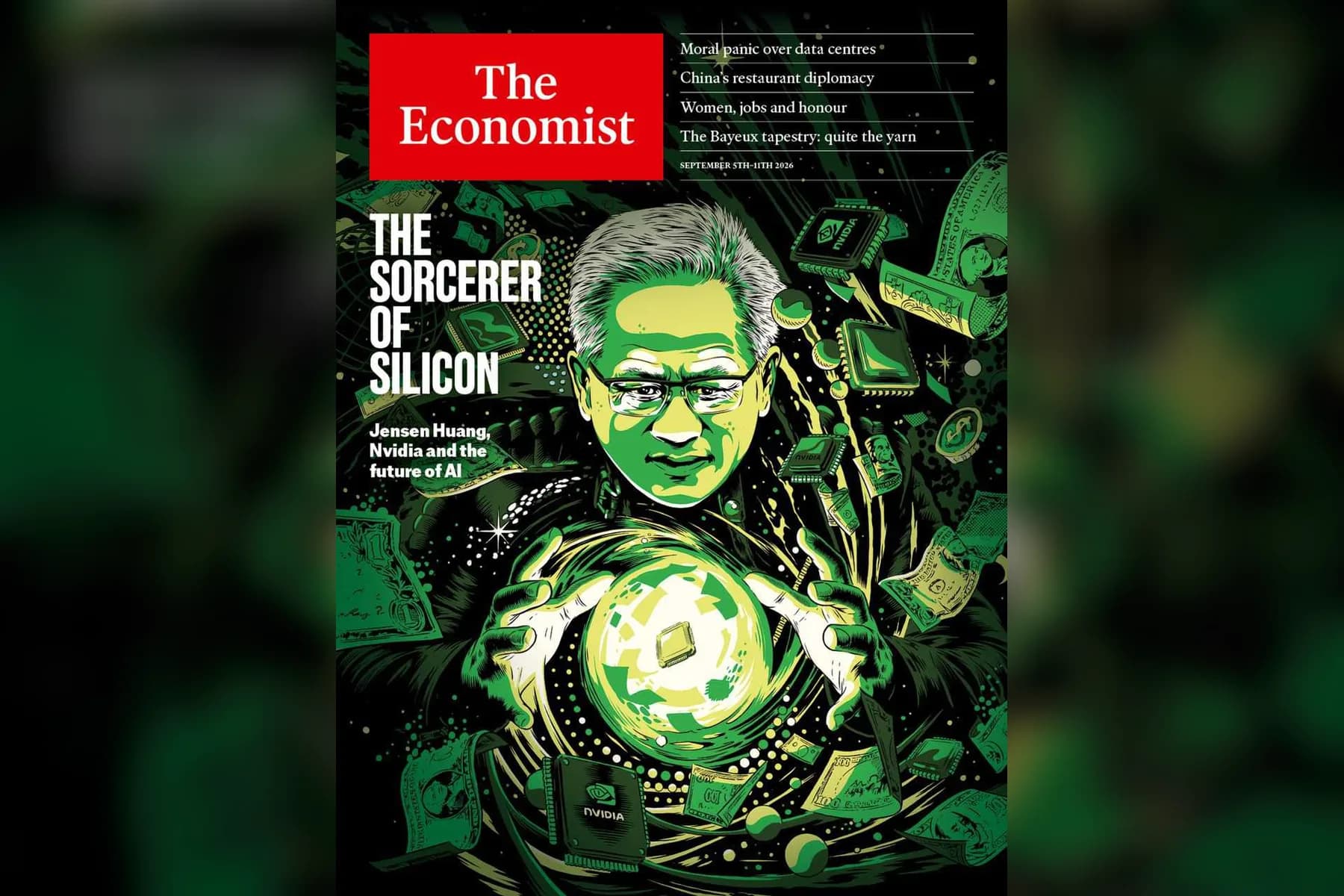
A company worth $5.4trn can make the world's most coveted chips and still worry that too few people will use what they enable. Nvidia is responding with something close to an industrial credit system: investing in customers, guaranteeing equipment values and promising to buy unused computing capacity. The apparent shortage is silicon. The consequential constraint may instead be adoption, electricity, local consent or the willingness of lenders to finance everyone outside the richest cloud companies.
That pattern runs through The Economist's September 5th issue. India has built a payment network used 25bn times in a month, but has not yet given banks a durable reason to maintain it. China can manufacture advanced robots yet struggles to keep formaldehyde off cabbages. Subsidised child care does little for Egyptian women whose husbands oppose paid work. London reduces knife violence not with one spectacular intervention, but by connecting police, schools, hospitals and youth workers.
A breakthrough expands what is technically possible; a system advances only when its neighbouring institutions can absorb, finance and govern the change. Capital, legitimacy, incentives, information and social permission are complements. When one is missing, pouring more resources into the celebrated core can magnify fragility rather than remove the bottleneck.
1. Nvidia is financing the demand its chips require
Nvidia's ascent is real rather than merely promotional. Its annual sales have roughly doubled in each of the past three years, gross margins have risen to 75%, and the company may generate about $200bn in cash this year. AI businesses are also earning real revenue—perhaps $150bn a year across American technology firms—even if that remains far below the roughly $2.5trn needed to cover the industry's planned capital spending by the end of the decade.
The risk lies in the bridge between those two numbers. Nvidia has pledged more than $70bn to startups and offered customers some $300bn of support. It may guarantee residual equipment values, top up a neocloud's income or become investor, supplier and buyer at once. CoreWeave, for example, has Nvidia as an 11% shareholder and a backstop for as much as $6.3bn of unused capacity. These arrangements narrow borrowing-cost gaps and bring infrastructure forward. They also make it harder to tell whether Nvidia is enabling demand or creating it.
The magazine's defence—that losses would fall mainly on shareholders—is broadly persuasive. Nvidia has cash rather than Cisco-style leverage, and concentrated entrepreneurial bets are part of capitalism. Yet the issue's reporting also shows why balance-sheet strength is not the whole test. The five largest listed neoclouds have expanded annual revenue from $3bn in 2024 to $18bn, while accumulating $61bn of debt and $18bn of operating leases. None makes an operating profit. If adoption slows, chips, loans, leases and customers will all be repriced together.
2. Adoption depends on work that can be tested and reorganised
Four-fifths of programmers use an AI coding tool, and coding supplies more than half the combined annual recurring revenue of Anthropic and OpenAI. Law, finance and customer service are growing, but coding enjoys unusual complements: abundant public training data, automated tests, digitally accessible context and workers accustomed to experimenting with new tools.
Elsewhere the relevant knowledge may sit in a call-centre employee's head or in a lawyer's reading of another person's expression. Errors are harder to test, regulations restrict experimentation and workers may have neither authority nor incentive to redesign a process from below. Better models help, but firms also need data pipelines, evaluation routines and organisational permission. The decisive unit of adoption is therefore not a model answering a prompt; it is a workplace learning how to verify and incorporate the answer.
This distinction also clarifies the data-centre backlash. American opposition reached 63% in one late-August poll, and counties considered 409 moratoriums in the first eight months of the year. Some fears are exaggerated: data centres used far less water than crop irrigation, and one estimate found that their demand reduced average electricity prices by spreading grid costs. But electricity use could reach 9.5-15.3% of the national total by 2030. Communities are not irrational to ask who pays for grid upgrades, noise and land. Scarcity pricing, large-load tariffs and credible local compensation would address that distributional question better than either blanket bans or dismissing every opponent as misinformed.
3. A free network eventually needs a business model
India's Unified Payments Interface demonstrates how removing friction can transform behaviour. In its first year UPI handled 73m transactions; this August it processed 25bn worth nearly 30trn rupees. More than 85% of India's non-cash transactions now pass through it. Simplicity, cheap mobile data and a ban on merchant fees helped turn a QR code into everyday infrastructure.
Success creates its own maintenance burden. Banks must keep networks reliable, deter fraud and continue innovating, while government subsidies cover only part of the cost. Parliament has therefore reopened the door to charges, probably for larger commercial payments. Users may ultimately bear some expense, but they already pay indirectly through taxes and underinvestment. An infant platform can rationally subsidise adoption; a mature utility that cannot pay its own way eventually consumes the reliability on which its popularity rests.
UPI and Nvidia occupy opposite financial positions but face the same design problem. One made access nearly free and must now fund the network. The other has abundant cash and is using it to make access to capital cheaper. In both cases the price signal must preserve expansion without hiding risk or starving upkeep.
4. Formal capacity fails when responsibility is fragmented
China's food system makes the gap between visible technology and mundane administration especially stark. Regulations are not dramatically weaker than Europe's, pesticide use has fallen and the country plans 500 additional cold-chain logistics centres. Yet truckers were still filmed dipping cabbages in formaldehyde, a practice reported as long ago as 2012.
The system contains 160m mostly small farmers, hundreds of thousands of transporters, neighbourhood markets and thin-margin restaurants. Oversight is similarly divided. When cooking oil was carried in tanks also used for fuel, responsibility could have belonged to the market regulator, the transport ministry or a strategic-resources office; in practice it fell through the cracks. Local officials are also rewarded for protecting jobs and industry, giving them reasons to suppress problems until a national scandal demands scapegoats.
Blockchain certificates and livestreamed kitchens can improve traceability, but they cannot assign responsibility or protect whistleblowers. Technology records what an institution chooses to see. Safe food requires inspection capacity, aligned promotion incentives and an authority accountable for the entire chain—not simply a more sophisticated database.
5. Social permission is productive infrastructure
In an Egyptian experiment, only 11% of married mothers accepted subsidised child care. The limiting factor was often not price or distance but husbands who considered outside work improper. Across South Asia only about a third of women participate in the labour force; in the Middle East and north Africa the share is one-fifth. The World Bank estimates that removing barriers to women's work could raise income per person by a fifth in many countries.
Law matters, but permission is produced inside families and communities. Saudi women's labour-force participation nearly doubled from 18% in 2010 to 34% after legal reforms. Paid work then changes bargaining power: across data from 27 countries, employed women reported more say over household money and movement even after income and national sexism were taken into account. Income is not merely the reward after norms change; it helps change the norm by making exclusion costly and independence credible.
The policy lesson is broader than gender. Child care, digital job listings and safe transport work best as complements to examples people can observe and trust. In one Indian study, a six-minute video about women in a safe factory made husbands and in-laws 35-57% more likely to permit wives to seek jobs. Institutions often move when a pioneer turns an abstract alternative into a socially legible life.
6. Coordination beats spectacle when causes are distributed
London's knife-related homicides have halved from their peak, and hospital admissions for assault with a sharp object have fallen by a third. The city's Violence Reduction Unit borrowed a Scottish model that connects police, schools, hospitals and sports clubs to identify vulnerable young people before gangs recruit them. A Home Office review attributed a 12% fall in violent hospital admissions among under-25s since 2019 to such units across England.
The evidence is not perfectly clean. Alcohol use and the number of nightclubs also fell, and some school visits show little effect. But the mechanism is credible because the cause is distributed: childhood adversity, school exclusion, trauma, drug markets and recruitment reinforce one another. No single agency sees the whole path. Coordination restricts the gangs' labour pool more effectively than punishment applied only after a stabbing.
Climate risk poses the same epistemic problem at a larger scale. Southern England's 2026 drought may reflect chaotic variability, or climate change may be altering atmospheric circulation and making persistent anticyclones more likely. Existing models struggle with the relevant scale interactions. That uncertainty is a reason to pool modelling capacity and prepare reservoirs or desalination options, not a licence for false precision or inaction. When the adjacent constraint is knowledge itself, resilience comes from monitoring and reversible preparation.
Reservations about this issue
The magazine sometimes treats efficient pricing as a more complete answer than its own reporting supports. Charging data centres for scarce power and water is preferable to arbitrary rationing, but prices do not automatically settle where facilities should be built, who bears transmission risk or how communities can verify promises. Markets need measurement, contracts and regulators—the very institutional complements the issue otherwise emphasises.
Its defence of Nvidia also draws the system boundary narrowly around shareholders. A failure might leave the company solvent while still stranding power infrastructure, hurting lenders or transmitting losses through pension funds and local tax bases. The relevant question is not whether Nvidia resembles a regulated bank in every respect, but whether its guarantees concentrate correlated risks outside ordinary disclosure categories.
Finally, the account of women's employment rightly identifies coercive norms but can make paid work sound uniformly emancipatory. Job quality, control of wages, safety and the redistribution of unpaid care determine whether employment expands freedom or simply adds another burden. Participation is an important measure; bargaining power and time are better tests of the outcome.
Four things to watch
- Whether AI revenue broadens beyond coding fast enough to support the infrastructure commitments now being made;
- Whether American states use large-load tariffs and enforceable community agreements to convert data-centre opposition into negotiated consent;
- Whether India's new UPI charges fund fraud prevention and reliability without pushing small merchants back to cash;
- Whether Chinese food-safety reform clarifies regulatory ownership and local incentives, rather than producing another short campaign after a scandal.
This issue's most useful correction is to the heroic story of innovation. Chips, payment rails, laws and predictive models matter, but none acts alone. Progress stalls where a celebrated system meets an unfunded operator, a hostile community, a fragmented regulator or a household veto. Finding the next bottleneck requires looking one institution away from the breakthrough—and treating that less glamorous work as part of the technology itself.
Expressions worth taking away
These ten expressions describe thresholds, hidden risk and the institutional work around a headline event. Each appears in this issue; every example sentence below is newly written.
1. come good
Function: Hedging
Meaning: To produce the hoped-for result after a period of uncertainty; common in British English when discussing a bet, promise or investment.
If the pilot comes good, the city can expand it without committing the entire budget today.
Use it for an uncertain project or expectation, not merely for something that is already successful.
2. smacks of
Function: Comparison
Meaning: Suggests an unpleasant resemblance, often without claiming exact equivalence.
Guaranteeing every buyer's loan smacks of an earlier boom, even if the balance sheets are stronger this time.
It usually introduces criticism: smacks of desperation, smacks of favouritism.
3. walking a fine line
Function: Contrast
Meaning: To operate between two outcomes that are difficult to distinguish or balance.
The regulator must walk a fine line between encouraging entry and tolerating unsafe operators.
Follow it with between A and B when the competing objectives need to be explicit.
4. a backstop
Function: Cause
Meaning: A guarantee or last-resort protection that limits losses if the primary arrangement fails.
A temporary public backstop kept credit flowing while private lenders reassessed the risk.
A backstop reduces downside; it does not necessarily prevent failure or remove moral hazard.
5. hinge on
Function: Cause
Meaning: To depend decisively on one condition or event.
The reform will hinge on whether local officials are rewarded for reporting problems rather than concealing them.
Use hinge on, not hinge in; the subject is often a plan, outcome or argument.
6. pay its own way
Function: Cause
Meaning: To generate enough revenue or value to cover its continuing costs.
Once the trial becomes national infrastructure, it must pay its own way without degrading access.
The phrase concerns operating sustainability, not necessarily profit maximisation.
7. fall through the cracks
Function: Cause
Meaning: To be missed because responsibility or information is divided between systems.
Complaints fell through the cracks because neither agency owned the full investigation.
It often diagnoses coordination failure rather than an individual mistake.
8. paves the way
Function: Cause
Meaning: To make a later change easier or possible by establishing precedent or conditions.
The first successful apprentices paved the way for families to accept the programme.
Usually followed by for plus a noun or for someone to plus a verb.
9. sand in the wheels
Function: Metaphor
Meaning: Friction that slows a process which would otherwise move more smoothly.
Unclear grid rules became sand in the wheels of an otherwise financeable project.
The phrase implies obstruction or friction, not a complete stop.
10. raise eyebrows
Function: Hedging
Meaning: To attract surprise, suspicion or mild disapproval without asserting that something is wrong.
The unexplained jump in maintenance costs should raise eyebrows before the contract is renewed.
It is useful when evidence warrants scrutiny but not yet a firm accusation.
Putting the expressions back into an argument
The investment may come good, but its circular guarantees should raise eyebrows. A backstop can pave the way for useful infrastructure; it can also become sand in the wheels of honest price discovery. Success will hinge on whether the network can eventually pay its own way without letting hidden liabilities fall through the cracks.
The paragraph first concedes that the investment may succeed, then marks uncertainty without alleging fraud. A backstop is presented as both an enabler and a possible distortion. The final sentence identifies two tests—financial sustainability and visible responsibility—that determine whether early support becomes durable infrastructure.
This article was generated by an agent from the September 5th 2026 issue of The Economist.
Conversation
Discussion
Loading responses…