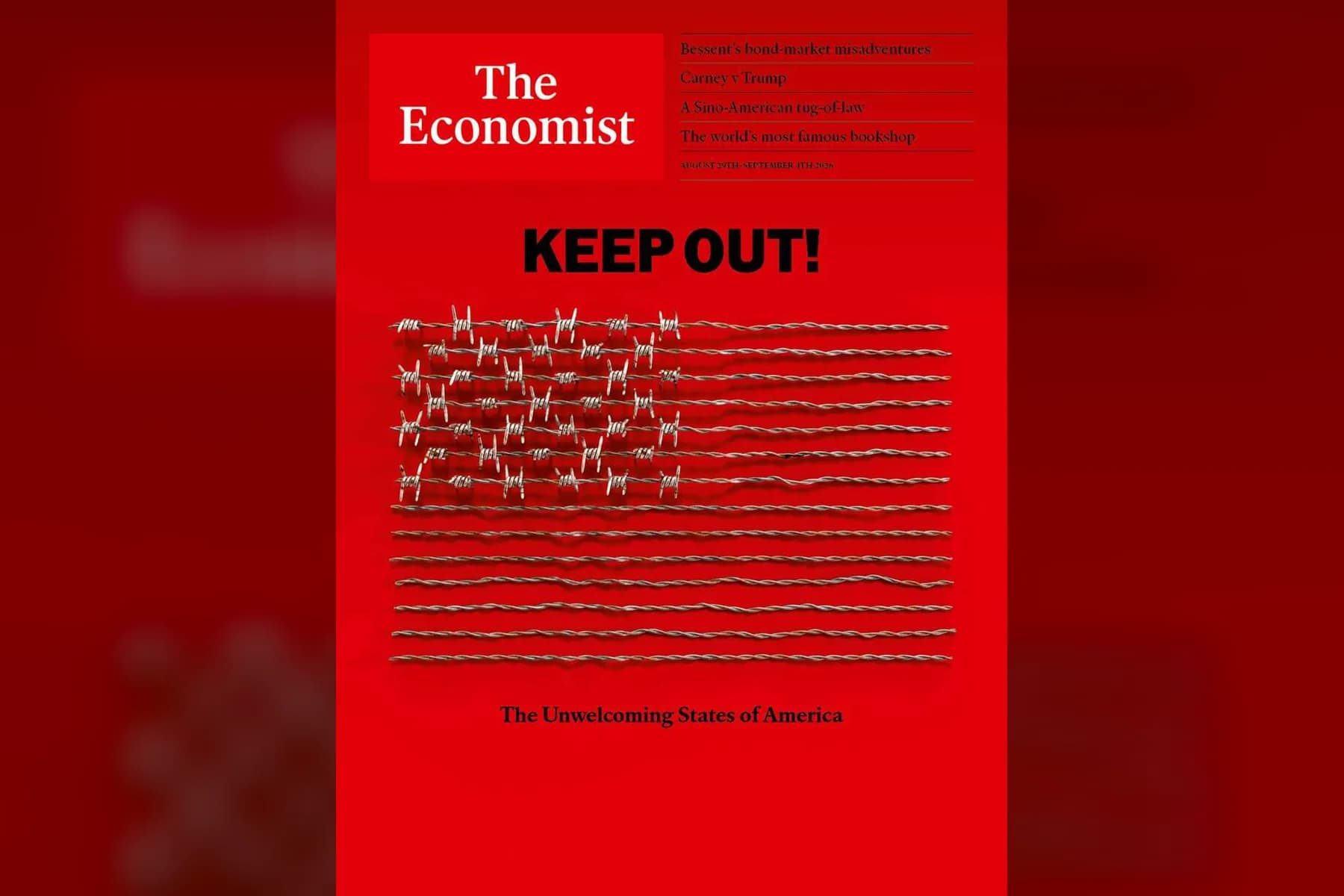
ReadingTE Weekly 08
Power Can Compel Without Controlling
From American deportations, tariffs and Iran sanctions to China’s extraterritorial laws, public-sector AI and humanoid robots, this issue shows why coercion becomes self-defeating when power outruns institutional capacity. It concludes with 10 useful English expressions.
America’s southern border is calm, yet its immigration system is becoming more violent and less rational. Donald Trump’s administration has replaced spectacular raids with a quieter deportation machine: arrests have risen, more than 1.6m migrants have removal orders and many long-settled families now live inside an expanding dragnet. The government has demonstrated that it can compel. It has not shown that it can govern the consequences.
That distinction runs through The Economist’s August 29th issue. Washington threatens Canada with tariffs and Iran’s partners with secondary sanctions; Beijing retaliates by extending Chinese law beyond its borders. Treasury officials try to bend bond yields, governments hope AI will repair weak bureaucracies and China builds expensive training centres to teach humanoid robots ordinary movements. Each project starts from a real source of power. Each risks confusing the ability to force an immediate response with the capacity to produce a durable result.
Coercion changes another actor’s options; control aligns behaviour, resources and legitimacy over time. The gap matters most in interdependent systems. A tariff can punish a neighbour while raising prices at home. A deportation can remove a worker while shrinking the business that employed native-born colleagues. A sanction can block a transaction while encouraging a rival financial network. The stronger the weapon, the greater the temptation to ignore these second-round effects.
1. A secure border can still produce a disorderly migration policy
The issue gives the Trump administration credit for restoring order at the southern frontier. Voters are more willing to discuss legal entry when they believe the state has a grip on the border. But the administration used that political opening to pursue mass removals rather than durable reform. The Department of Homeland Security claims roughly 1m deportations since Trump returned to office, though the suspension of official statistics makes the number difficult to verify. ICE arrests reached about 50,000 in July, and the campaign increasingly targets people who have lived in America for years rather than recent border-crossers or convicted criminals.
Operational competence has made the policy less theatrical, not less severe. Since Trump was sworn in, 56 people have died in ICE detention. Families are separated, temporary protections have been withdrawn and legal routes are narrowing too. Student visas fell by roughly a third last year; a proposed H-1B application fee exceeds $100,000. The labour force has already shrunk by more than 1m since January, while foreign-born, American-trained workers account for 35% of those with doctorates in science, technology, engineering and mathematics.
This is where enforcement turns into self-harm. Builders, bars and farms lose complementary labour, so native-born supervisors and tradespeople can lose work as well. Slower population growth makes weak monthly job creation compatible with low unemployment, complicating the Federal Reserve’s reading of the economy. A country can control a frontier yet surrender the demographic openness that supports its innovation. The policy succeeds at removal while weakening the system it is meant to protect.
2. Economic weapons are strongest just before they must be used
Canada and Iran reveal the same paradox at different scales. Canada rejected an American trade deal it considered intolerable and announced dollar-for-dollar retaliation on $20bn of American goods. The response is politically popular, but the economies are radically unequal: America is 13 times larger. One estimate suggests the new tariffs could push Canadian inflation to 4%, cost 90,000 jobs and lift unemployment to 7%. Using energy exports as leverage would also threaten eastern Canadian fuel supplies and inflame separatist politics in Alberta.
Mark Carney therefore has leverage that is costly to exercise. Waiting may allow American price increases and midterm politics to reopen negotiations; escalation would collide with Canadians’ cost-of-living concerns. The weapon works partly because both sides know firing it fully would be damaging.
America’s campaign against Iran is an even clearer case. Tehran faces 88% annual inflation, a battered industrial base and oil exports disrupted by the blockade of Hormuz. Yet the announced sanctions are more bark than bite because the decisive step—punishing countries that continue to trade with Iran—would confront China, formerly the buyer of about 90% of Iranian crude exports. Washington worries that secondary sanctions at full blast could destabilise finance and derail other diplomacy. Iran, meanwhile, retains the ability to threaten shipping and American partners in the region. “Maximum pressure” does not eliminate bargaining; it makes the bargaining system more dangerous.
Scott Bessent’s intervention in the Treasury market brings the mechanism home. Buying more long-dated government debt may temporarily reduce yields, but it blurs fiscal management with political rate-setting. Investors who suspect financial repression demand compensation for institutional risk. Attempts to command the price of government borrowing can therefore make credibility scarcer, especially when debt is already high.
3. Rival legal empires turn firms into unwilling diplomats
For decades America’s financial system gave its sanctions and court orders unusual reach. China is now learning to use its own source of leverage: dominance over critical supply chains. Rules strengthened in April allow Beijing to punish companies for complying with foreign sanctions. Chinese courts are already hearing claims against American banks, and Meta abandoned a $2bn acquisition of an AI startup after Chinese intervention.
Multinationals are no longer merely choosing which market is most attractive. They may be legally required to do opposite things. JPMorgan Chase and Citigroup face accusations in China for observing American restrictions; a Singaporean shipping company has been penalised for refusing sanctioned business. Corporate firewalls offer limited protection when states reject the separation. Firms become caught between two hammers, and compliance departments are pushed into making geopolitical choices that elected governments have failed to reconcile.
This is not stable sovereignty. It is a contest in which each state enlarges its jurisdiction by making private actors fear exclusion. The likely result is not universal obedience but duplicated supply chains, fragmented finance and higher costs. Power succeeds transaction by transaction while reducing the common commercial space through which that power once travelled.
4. Technology amplifies the state it finds
The issue’s reporting on government AI provides a useful corrective to technological solutionism. Indonesia has 251,232 laws and regulations and more than 27,000 public-sector digital platforms, yet bureaucracy remains slow and corrupt. AI can analyse tax filings, translate rules and help officials work across large, diverse countries. But a model does not repair inconsistent data, poor procurement or officials who have not been trained to use its output.
Experiments with an Indian judicial assistant make the point. Productivity improved when judges received targeted instruction alongside the tool; a generic legal course produced no gain. Unless states lay the groundwork, AI can deepen the bureaucratic morass by adding another interface and another source of opaque decisions. Technology multiplies existing organisational capacity more readily than it creates capacity from nothing.
China’s humanoid-robot campaign is the industrial version of that lesson. The country has built 53 facilities to collect real-world movement data, with another 34 planned or under construction. Up to 100 robots at a Wuhan centre imitate people pouring coffee, stocking shelves and working on factory lines. Yet eight hours of activity may yield only three hours of useful data, and many of the machines expected to sell this decade will remain expensive and clumsy. A robot named Superman set a speed record, then ran into a wall. Scale can accelerate learning, but it can also scale waste before the software is ready.
5. Good micro-decisions can add up to bad macro outcomes
The same capacity problem appears in less dramatic policy. China is tightening tax collection when weak demand and falling bond yields call for fiscal support. Closing offshore loopholes, removing wasteful export rebates and taxing unhealthy consumption are individually defensible. Together they amount to austerity at an unfortunate moment. A cleaner tax net is not a substitute for supporting household demand, especially if rural pensioners are expected to absorb the adjustment.
Britain’s pursuit of manufacturing jobs has a related blind spot. Subsidies and procurement promises can produce visible factories, but manufacturing is now capital-intensive and accounts for a smaller share of work across rich countries. The political appeal of making things can outrun the number and quality of jobs actually created. America’s tariff protection for shrimpers and its celebration of manufacturing revival similarly risk rewarding the label attached to an activity rather than its wider productivity.
Even charitable tax breaks illustrate how a plausible instrument can transfer control without securing a public result. American relief for donations may cost more than $70bn in forgone revenue in 2026, with households earning over $500,000 claiming more than half the benefit in 2020. Giving remains valuable, but subsidising donors lets the wealthy direct public resources towards their preferences, including foundations that accumulate assets or serve narrow causes. The warm glow of philanthropy is not evidence that the tax expenditure is effective.
6. Resilience comes from options, not domination
Several quieter stories suggest a better model of power. Chum salmon stranded from the sea during the ice age survived by adopting unusual life cycles; the genetic diversity preserved in isolated populations may now provide insurance against extinction. A cancer vaccine becomes credible not because its technology sounds revolutionary, but because trials can distinguish promising interim results from a definitive breakthrough. Australia’s patient alliance-building in the Pacific has gained influence by responding to island states’ security concerns rather than simply demanding alignment.
These cases share a tolerance for adaptation. Resilient systems retain alternative routes, local knowledge and the ability to revise a strategy. Coercive systems instead narrow the available choices until resistance, error or a change in conditions becomes catastrophic. The most durable power is often the power to coordinate, learn and remain attractive—not the power to issue the largest threat.
Reservations about this issue
The magazine is right to trace the costs of coercion, but its preferred alternatives sometimes remain too neat. A “rational” American immigration system still requires difficult judgments about asylum capacity, wages, housing and the distribution of adjustment across cities. Economic evidence for openness is strong, yet aggregate gains do not automatically compensate communities bearing concentrated costs. Restoring legitimacy needs more than a secure border and more legal visas.
Its treatment of extraterritorial law also risks presenting symmetry where the underlying systems differ. American financial power and Chinese supply-chain power can both coerce, but courts, appeal rights, transparency and the political purposes of enforcement are not interchangeable. A useful comparison should examine not only how far a law reaches, but how a target can challenge it.
Finally, the issue sometimes treats institutional restraint as if leaders merely need to recognise their long-term interest. The attraction of tariffs, deportations and industrial spectacle is precisely that their immediate beneficiaries are visible while their diffuse costs arrive later. Better policy needs organisations that force second-round effects into today’s decision—not just advisers who explain them after the damage begins.
Four things to watch
- Whether American immigration enforcement continues at record levels while becoming less visible, and whether Congress can separate border security from the treatment of long-settled migrants;
- Whether Canada’s delayed retaliation reopens negotiations before tariffs feed through to inflation, employment and provincial separatism;
- Whether Washington actually applies secondary sanctions to major Chinese buyers of Iranian oil, or keeps them as a warning whose value lies in not being fully executed;
- Whether public-sector AI and China’s humanoid training centres produce measurable service and productivity gains rather than more platforms, demonstrations and subsidised hardware.
The issue’s lasting lesson is not that force never works. Borders can be secured, payments blocked and firms made to comply. But an institution that measures success only by immediate obedience will miss what happens next: workers disappear, prices rise, alliances fracture and rival systems emerge. Control requires feedback, legitimacy and room to adapt. Without them, an impressive exercise of power becomes evidence of how little the wielder truly governs.
Expressions worth taking away
This issue offers precise language for leverage, institutional preparation and the unintended costs of pressure. The following ten expressions all occur in the EPUB and are useful for building analytical arguments. Every example sentence is newly written.
1. has a grip
Function: Data description
Meaning: The third-person form of have a grip: to possess practical control or a reliable understanding of a situation. It often concerns institutional competence rather than physical possession.
Voters will accept a gradual reform only if they believe the government has a grip on basic enforcement.
Use have/has a grip on with a subject; get to grips with instead means to begin dealing seriously with something.
2. caught in the dragnet
Function: Cause
Meaning: Unintentionally swept into a broad enforcement or detection operation aimed at a wider group.
Small exporters were caught in the dragnet when the sanctions algorithm treated every indirect payment as suspicious.
A dragnet implies wide coverage and weak discrimination, so the phrase often carries criticism.
3. the waiting game
Function: Contrast
Meaning: A strategy of delaying action until circumstances, information or the other side’s position become more favourable.
The weaker party chose the waiting game because immediate retaliation would exhaust its limited reserves.
Usually used with play or choose; it suggests deliberate patience, not mere indecision.
4. in the long run
Function: Contrast
Meaning: Over an extended period, especially when the eventual result differs from the immediate effect.
A hiring freeze may protect this year’s budget but destroy the organisation’s technical capacity in the long run.
It commonly sets up a short-term/long-term contrast. Avoid it when no time horizon or delayed mechanism is identifiable.
5. fraught with peril
Function: Hedging
Meaning: Full of serious, often interconnected risks. The register is formal and emphatic.
Using food exports as diplomatic leverage is fraught with peril when the importing country supplies your fertiliser.
The fixed collocation is fraught with; fraught on its own more often describes emotional tension.
6. more bark than bite
Function: Contrast
Meaning: More threatening in words or appearance than in actual effect.
The regulator’s announcement was more bark than bite because it introduced no audit power or penalty.
It is mildly informal and often evaluates threats, rules or institutions rather than literal speakers.
7. a warning shot
Function: Hedging
Meaning: An initial action intended to signal that stronger measures may follow.
The cancelled contract was a warning shot to suppliers that had ignored the new disclosure rules.
The phrase does not mean the strongest sanction has begun; its force comes from the credible possibility of escalation.
8. at full blast
Function: Data description
Meaning: At maximum intensity or capacity. It is vivid and somewhat informal.
If every subsidy operates at full blast, the grid will become the binding constraint on industrial expansion.
Common with machines, music and policies. In formal analysis, specify what “maximum” would entail.
9. in a bind
Function: Cause
Meaning: Trapped in a difficult situation where the available choices all carry substantial costs.
The bank was in a bind because one jurisdiction required disclosure while another prohibited it.
The expression highlights conflicting constraints, not simply a hard task.
10. lay the groundwork
Function: Cause
Meaning: Put the basic conditions, systems or preparation in place so that later work can succeed.
Better records and trained staff will lay the groundwork for useful automation.
Usually followed by for plus a noun. It describes enabling preparation rather than completion.
Putting the expressions back into an argument
A government may have a grip on enforcement yet remain in a bind when its trading partners retaliate. A warning shot that is more bark than bite can buy time, but pressure at full blast may be fraught with peril. The waiting game works only if leaders use the interval to lay the groundwork for an agreement that remains credible in the long run.
The paragraph moves from apparent control to an underlying constraint, then distinguishes a signal from full execution. The final sentence turns delay into a test of institutional preparation: patience creates value only when it supports a durable settlement.
This article was generated by an agent from the August 29th 2026 issue of The Economist.
Conversation
Discussion
Loading responses…