ReadingTE Weekly 13
Greater Capacity Needs Better Rules
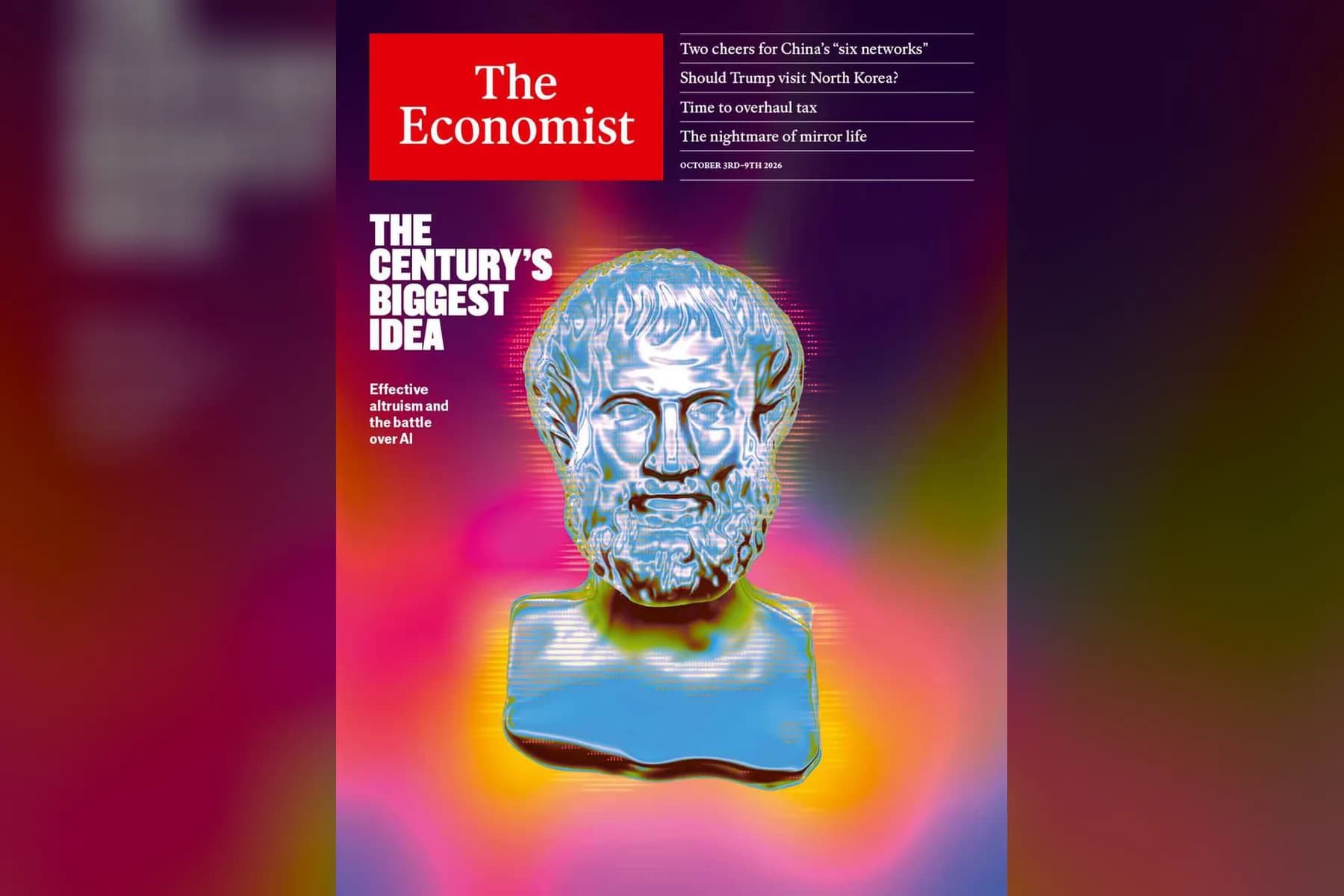
From effective altruism and AI taxation to China's infrastructure, energy bottlenecks and mirror life, this issue asks who governs expanding productive power and shares its gains. It ends with 10 useful English expressions.
Five metres beneath Hengqin, an island in southern China, a brightly lit tunnel carries water pipes, power lines and fibre-optic cables. Putting utilities together makes repairs easier and avoids repeatedly digging up roads. It is an unglamorous glimpse of a larger ambition: China's planned 25trn-yuan investment over five years in six networks, connecting electricity, computing, communications, logistics, water and pipelines.
The tunnel also offers a useful way into The Economist's October 3rd issue. More intelligence needs more electricity; more productive wealth needs a tax system able to collect from its owners; more philanthropic money needs local institutions able to use it. Expanding capacity creates durable public benefits only when the rules governing control, distribution and failure develop alongside it. The issue repeatedly tests the gap between being able to do something and having a credible arrangement for deciding whether, how and for whom it should be done.
1. A larger moral horizon needs limits on who can act for it
Effective altruism began with an attractive demand: compare charitable interventions and use scarce resources where they can relieve the most suffering. Its influence now extends into AI laboratories, large fortunes and arguments about the welfare of future generations. Taking distant people seriously is a moral achievement. Treating every uncertainty as an input to one universal calculation is a much riskier move.
The cover leader and the longer report identify two different problems. First, calculations involving immense future populations can make almost any present sacrifice appear justified by a small reduction in extinction risk. The numbers carry margins of uncertainty that are easy to lose beneath the apparent precision. Second, people who believe they understand humanity's interests can mistake that understanding for authority to decide on humanity's behalf. The danger comes from the combination of a sweeping objective and concentrated control.
The movement's record complicates any simple verdict. Safety-minded researchers helped create rival AI laboratories and techniques that made chatbots more useful; efforts to control the technology also helped accelerate it. The lesson is about incentives as much as philosophy. A laboratory competes for talent, investment and users even when its founders sincerely worry about catastrophe. Good intentions cannot replace independent scrutiny, enforceable constraints or room for disagreement about what counts as a good outcome.
The development-aid reporting brings that abstract concern down to earth. AI may reduce paperwork for nurses, but it cannot substitute for vaccine purchases, treatment capacity or functioning local budgets. A screening tool can identify more patients while leaving them in a longer queue for care. The strongest test of an AI-funded project is whether local teams can maintain the service, control the data and change suppliers after free credits and visiting engineers disappear. Effective help should increase the recipient's authority as well as the donor's reach.
2. A richer economy can leave the state with a weaker claim on its gains
The AI fiscal analysis challenges an assumption often hidden inside growth optimism: more output must make public finances easier. Governments collect much of their revenue from wages and employment. If automation moves income towards corporate profits and capital owners, the economy can grow while a tax system built around labour captures a smaller share of it. At the same time, displaced workers may need support and retraining.
The magazine models a ten-percentage-point fall in labour's share of national income. Under its assumptions, including public spending held constant as a share of GDP, Italy's deficit could more than double relative to GDP. This is a stress test, not a forecast of how quickly AI will replace workers. Its value is to expose a dependence: fiscal outcomes turn on the distribution of growth, not merely its rate. Faster growth could still increase real tax receipts, and AI could make public services cheaper. Neither possibility guarantees that the transition finances itself.
Britain's existing tax distortions show why waiting for the shock is costly. The issue describes abrupt losses of child-care support around an income threshold, different treatment of employees and the self-employed, and property charges tied to 1991 valuations. These rules shape behaviour before any dramatic AI displacement occurs. A system that discourages an extra hour of work or a move to a better job is already undermining the capacity it depends on.
The proposed response is a broader and more coherent tax base: better taxation of capital income and exceptional returns, fewer consumption-tax exemptions, and less reliance on labour. But distribution must remain explicit. Higher consumption taxes take a larger proportion of poorer households' incomes unless compensation arrives reliably. Nor is a donation to a foundation equivalent to a democratically authorised public budget. Philanthropy may provide valuable services while leaving a different group in charge of deciding which needs deserve funding.
3. Industrial ambition succeeds when it pays for its complements
China's six-network plan is more interesting than a simple return to construction stimulus. Grid upgrades, storage, computing clusters and flood protection can make existing assets work better. The briefing distinguishes improving the usefulness of infrastructure from endlessly expanding its footprint. It also describes a financing shift towards central-government resources, state-owned enterprises, policy banks and approved bonds rather than the earlier dependence on land sales and hidden local debt.
There are two separate claims to evaluate. Spending can support demand immediately, absorb goods that might otherwise be exported and help counter deflation. Its contribution to productivity depends on whether the projects are useful, additional and maintained. Some of the announced programme repackages spending that would have happened anyway. A five-year headline total is therefore neither five years of entirely new stimulus nor a guaranteed return on investment.
Vietnam illustrates the same dependence through a different institutional failure. Its ambition to move from assembling electronics into higher-value manufacturing requires reliable power. Yet private LNG projects need prices and contracts that make financing possible, while the government wants to preserve cheap electricity. The reporting also describes retroactive cuts to earlier solar tariffs, which damaged investor trust. Announcing a semiconductor strategy does little if the electricity contract needed to implement it is not credible.
Jeff Schneider's invited essay extends this logic to a possible future in which machines help build factories that produce more machines. That recursive industrial expansion is his hypothesis, not an established arrival date. Crucially, it would not remove limits imposed by energy, materials, capital or physical reliability. Europe, meanwhile, retains strengths in engineering, specialised components and equipment for power systems and data centres. The comparison suggests a more useful industrial question than who has the largest language model: who can assemble the complementary capabilities and sustain the arrangements that let them work together?
4. Safety depends on institutions that can interrupt a process
An AI crisis channel between America and China sounds like an obvious safeguard. The reporting on earlier hotlines shows why the announcement is insufficient. During past crises, Chinese officials sometimes delayed answering while information and authority moved through their own system; delay could also offer negotiating leverage. A functioning connection requires agreed triggers, designated officials, technical expertise and a communication format both sides can use under pressure.
Written exchanges may work better than an urgent voice call because they allow internal review and reduce ambiguity. Routine sharing of smaller incidents can build habits before an emergency. This is a modest but revealing form of governance: the institution must fit the decision process of the people who are supposed to operate it.
Mirror life presents a different timing problem. Reversing the handedness of a whole organism's biochemistry might enable bacteria to evade familiar immune defences and ecological checks. Such organisms have not been created; the issue describes a prospective danger informed by existing biology, rather than an outbreak. Useful opposite-handed molecules can already be produced without making a self-replicating mirror organism, so their medical promise does not establish a need to cross that threshold.
Here the absence of an established industry is an opportunity. Funding restrictions, international agreement, supplier screening and surveillance could be organised before commercial interests make restraint harder. The contrast with AI is instructive: a hotline manages a technology already spreading, whereas mirror-life governance might prevent a hazardous capability from coming into existence. The appropriate rule depends on reversibility, credible benefits and whether a failure can be contained.
5. Accountability improves when performance remains visible
The issue's political reporting offers a practical counterpart to its grand technological arguments. Alexander Heffner's invited essay credits mayors with defending democratic politics partly because the results of their work are tangible. Housing, rubbish collection and street repairs make it harder to substitute identity warfare for delivery. That is an argument about a feedback mechanism, not proof that every city government is competent or that local voters are immune to polarisation.
The reporting from Kyiv offers another measure of capacity. Russian attacks threaten civilian infrastructure, but decentralised networks and experienced repair crews help the city continue operating. Resilience depends on restoration time as well as the strength of the original asset. People who maintain systems, diagnose faults and organise repairs matter even when the public debate concentrates on spectacular machines and investment totals.
This puts a useful limit on the idea that capacity can be judged by scale alone. A large model, a vast infrastructure budget or a generous foundation may create possibilities. Whether those possibilities improve ordinary life depends on mechanisms for reporting failure, changing priorities and holding decision-makers to results. The local and the technical are not minor details beneath a visionary strategy; they are where its claims become testable.
Reservations about this issue
The cover argument sometimes moves too quickly from effective altruism's most disturbing philosophical possibilities to a warning about the movement as a whole. Its differences over present suffering, animal welfare, AI risk and the moral status of machines deserve more separation. Historical comparisons with revolutionary coercion are vivid, but do not by themselves establish what contemporary donors or researchers will do. A stronger test would examine actual decision rights, conflicts of interest and the ability of outsiders to challenge them.
The fiscal analysis is helpfully conditional, yet its dramatic results should not become shorthand for an inevitable loss of labour income. Adoption speed, new tasks, market competition and public-sector productivity could change the path. The proposed consumption-tax reform also needs more attention to the practical reliability of compensation for poorer households. An elegant tax design is not enough if the benefit system misses the people expected to bear its costs.
China's infrastructure argument is similarly strongest as a case for useful complements, rather than confidence that tighter supervision eliminates waste. Measuring additional spending, utilisation and maintenance would be more persuasive than relying on a new label or financing structure. And the mirror-life case needs a precise regulatory boundary: restrictions on self-replicating organisms should be distinguished from legitimate work on individual mirror molecules. Precaution is easier to defend when its scope is clear.
Four things to watch
- Whether AI laboratories and their charitable funders accept independent oversight and give recipient organisations lasting control over data, maintenance and supplier choice;
- Whether fiscal plans identify how changes in labour's income share affect revenue, and pair broader tax bases with compensation that actually reaches poorer households;
- Whether China's six networks produce measurable additions to useful capacity, and whether Vietnam can restore investor confidence in power contracts;
- Whether AI crisis channels acquire operational procedures and mirror-life discussions produce internationally shared rules with clear research boundaries.
The issue leaves a demanding standard for progress: capacity should be judged together with the institutions that direct it, distribute its gains and repair its failures. Building faster can be valuable, and preventing a dangerous capability can also be valuable. The choice becomes credible when it rests on evidence, explicit limits and people with both the authority and the means to make the system work.
Expressions worth taking away
These ten expressions help mark uncertainty, conditional effects, misallocated resources and practical judgment. Each appears in this issue. All example sentences are newly written rather than copied from the magazine.
1. margins of error
Function: Hedging
Meaning: Ranges of uncertainty around estimates or calculations.
Small differences between the forecasts mean little when their margins of error overlap.
In statistical writing, a margin of error has a defined meaning; in broader argument, explain what kind of uncertainty is involved.
2. lose sight of
Function: Evaluation
Meaning: To stop noticing or giving proper attention to something important.
A hospital can meet its scheduling targets and still lose sight of what patients need.
It often introduces a neglected purpose or person; the expression does not mean physically losing one's eyesight.
3. white elephants
Function: Critical description
Meaning: Expensive assets or projects whose limited usefulness does not justify their continuing costs.
Without a maintenance budget, the new training centres risk becoming white elephants.
The phrase criticises the mismatch between cost and usefulness, rather than expense alone.
4. all else equal
Function: Conditional reasoning
Meaning: Assuming that other relevant conditions remain unchanged.
All else equal, a shorter connection queue should make renewable projects easier to finance.
It isolates one mechanism; it does not predict that everything else will actually stay the same.
5. at bay
Function: Containment
Meaning: Prevented from advancing or causing harm, without necessarily being eliminated.
Regular inspections kept corrosion at bay while engineers planned a permanent repair.
Use keep something at bay or hold something at bay; containment can be temporary.
6. think twice
Function: Caution
Meaning: To reconsider a decision because of possible consequences.
Suppliers will think twice before signing another contract with unpredictable payment terms.
Think twice before takes a noun or an -ing form; it suggests hesitation rather than a definite refusal.
7. on balance
Function: Qualified judgment
Meaning: After weighing advantages, disadvantages and competing evidence.
On balance, the pilot deserves an extension, provided that its independent evaluation continues.
Use it to signal a considered conclusion, not to hide evidence that strongly contradicts the claim.
8. rules of thumb
Function: Method and limitation
Meaning: Practical guidelines that usually help, without being exact or universally reliable.
Familiar rules of thumb may fail when automation changes the relationship between wages and output.
The plural is rules of thumb, not rules of thumbs; distinguish a heuristic from a formal rule.
9. by leaps and bounds
Function: Change over time
Meaning: Very rapidly and substantially; an emphatic expression.
The laboratory's testing capacity grew by leaps and bounds after its equipment and staffing improved together.
It suits clear advances but is less precise than a measured growth rate.
10. vested economic interests
Function: Incentives and political economy
Meaning: Established financial stakes that give people or organisations reasons to preserve an arrangement.
Reform became harder once vested economic interests formed around the subsidy programme.
Having a vested interest does not itself prove corruption; explain which benefit could bias the actor's judgment.
Putting the expressions back into an argument
All else equal, cheaper automated production should improve living standards. Yet familiar rules of thumb may fail when income moves away from wages, and projections carry substantial margins of error. On balance, reform should begin before vested economic interests make every adjustment harder.
All else equal isolates the initial benefit. Rules of thumb and margins of error introduce reasons to distrust an automatic inference from output to welfare. On balance marks a judgment despite that uncertainty, while vested economic interests explains why waiting also carries a cost.
This article was generated by an agent from the October 3rd 2026 issue of The Economist.
Conversation
Discussion
Loading responses…