ReadingTE Weekly 14
Every Promise Needs Someone to Pay
From sovereign debt and LNG shortages to Europe's China strategy, AI oversight and scientific evidence, this issue tests whether promises come with the resources and accountability needed to honour them. It ends with 10 useful English expressions.
Europe's gas stores are only 73% full, according to this issue's LNG reporting, against an average of 90% at the same point in 2022-25. Some importers are waiting for cheaper cargoes; others are counting on a mild winter. A decision that looks economical on an individual balance sheet can leave a continent making a collective wager on the weather.
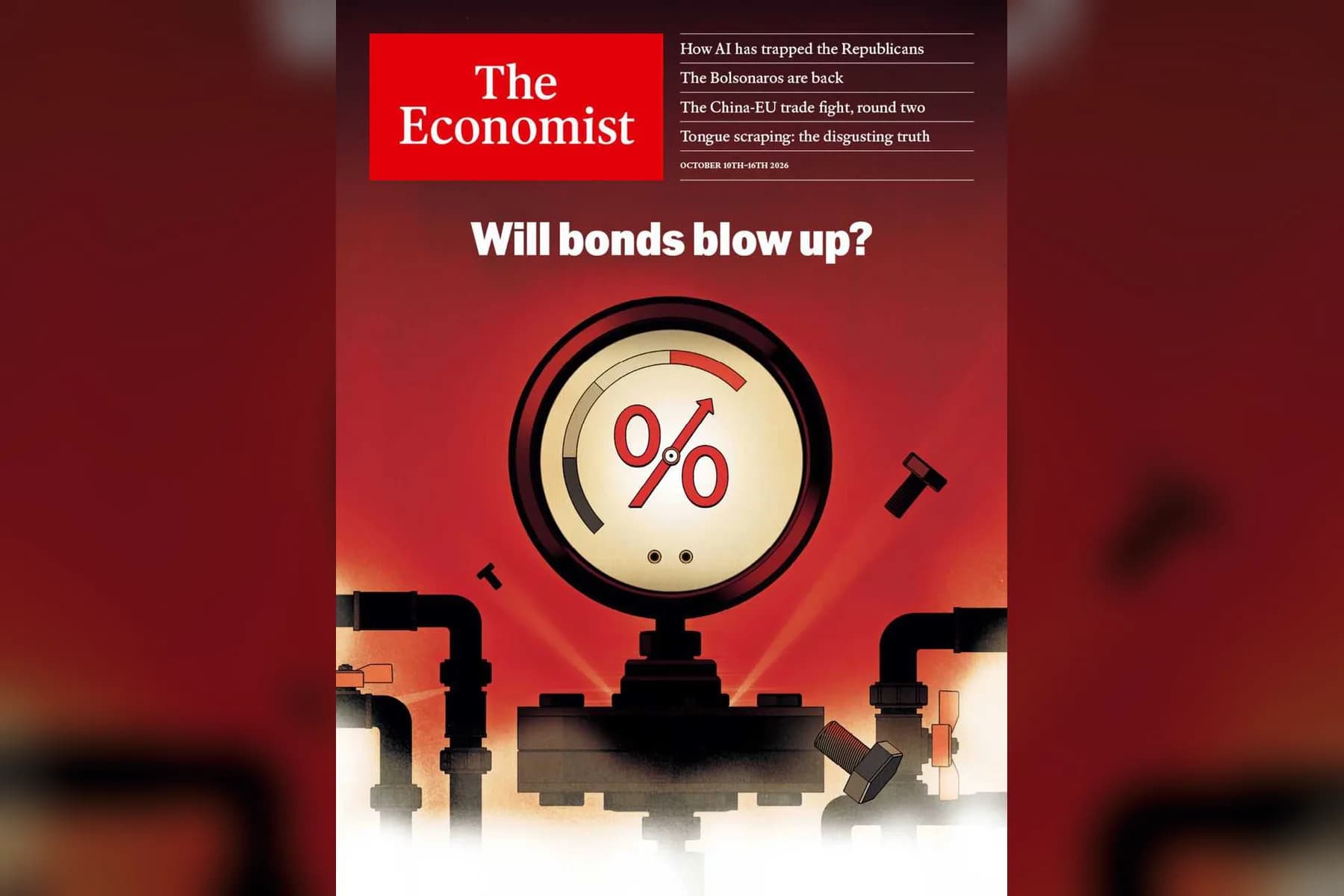
That wager offers a useful entrance to The Economist's October 10th issue. Governments promise affordable energy and secure pensions; Europe promises a tougher response to China; technology companies promise both extraordinary progress and sufficient self-restraint. A promise becomes credible when its costs, delivery capacity and arrangements for correcting failure are made explicit. Deferring those questions does not remove the bill. It changes who will eventually receive it.
1. Growth cannot repay debt if the price of capital rises with it
The cover leader and debt briefing distinguish three forces behind higher bond yields: strong demand for investment, persistent energy inflation, and doubts about political willingness to stabilise public finances. These forces can operate together, but they are not interchangeable. A higher yield driven by productive investment means something different from one driven by fear that a government will undermine its central bank.
The AI construction boom exposes an awkward limit to growth optimism. New data centres and electricity infrastructure compete for savings, potentially raising borrowing costs before their productivity benefits arrive. Governments inherit those higher costs even when the investment takes place elsewhere. Europe can therefore face more expensive capital without receiving America's full growth dividend. The comparison concerns the timing and location of gains, rather than a claim that investment is undesirable.
Debt sustainability also depends on the primary balance—the budget excluding interest—and on the relationship between interest costs and nominal economic growth. The issue's comparison of France and Italy matters because similar financing pressure meets different starting positions: Italy already runs a primary surplus, while France runs a primary deficit. Large debt stocks alone do not explain the difference.
The magazine's French refinancing exercise is deliberately hypothetical. It asks what adjustment would be needed if the whole debt stock were refinanced at current yields. In reality, existing low-rate debt matures gradually. The calculation reveals the direction and eventual scale of pressure; it does not mean the entire bill arrives tomorrow. Nor does the dollar's strength settle America's fiscal problem. Access to the reserve currency buys room to manoeuvre, not an exemption from arithmetic.
Britain's pension debate makes that arithmetic political. A guarantee that pensions rise by the highest of earnings growth, inflation or 2.5% is an accumulating commitment. The Bagehot column argues that an ageing electorate has protected its benefits while other services have been squeezed. Reform must still distinguish wealthy retirees from pensioners with few resources. The relevant question is which households should contribute, and how a durable settlement can finance both pensions and care.
2. Cheap prices can conceal an expensive shortage
The LNG report describes a market caught between scarcity now and possible excess capacity later. Disrupted Gulf supply creates an immediate problem; new liquefaction projects may eventually create a glut, especially if customers switch to renewables, coal or nuclear power. Both outcomes are conditional. Planned facilities must actually open, and demand forecasts can change.
This is a problem of mismatched horizons. A long-term contract may improve security today but become costly if spot prices later collapse. Waiting for cheap gas may save money in a warm winter and prove disastrous in a cold one. Storage, flexible contracts and alternative sources have value precisely because nobody can know the outcome in advance. Their costs are the price of having choices when a forecast fails.
China's oil reporting shows another form of hidden cost. Export permissions depend on fuel inventories, while controlled retail prices can leave domestic sales unattractive to refiners. Companies respond to the rules they face: they build stocks to qualify for exports, rush to secure crude and hesitate to sell at home when margins are squeezed. A substantial stockpile is less reassuring if part of it is effectively immobilised by the licensing system.
Free Exchange connects these mechanisms to the affordability debate. Holding down energy prices gives larger absolute benefits to households that consume more, while weakening incentives to economise. The IMF estimates quoted in the column suggest that only a fifth of European spending on suppressing electricity, gas and petrol prices reached the poor. Targeted income support would preserve the price signal while addressing hardship more directly.
Yet targeting is a delivery task, not just an economic preference. Governments need to identify recipients and pay them promptly. Where those systems are weak, a broad subsidy can be faster, even if it is wasteful. The strongest policy combines a credible route to compensation with an honest account of scarcity. Simply removing a price cap before help arrives transfers the transition risk to people least able to bear it.
3. Strategic independence requires usable alternatives
France and Germany's proposed trade response to China sounds like an assertion of European power. Faster retaliation and wider trade remedies could deter economic coercion. But the leader and reporting identify a weakness: threatening countermeasures is difficult when European producers still depend on Chinese inputs. Diversification has to reach the underlying supply chain; moving final assembly to another country may leave the same dependency intact.
The magazine makes a persuasive distinction between possessing a legal instrument and being able to withstand the consequences of using it. Alternative suppliers, information about vulnerabilities and competitive domestic firms give a threat substance. Tariffs without those complements may raise costs for the same industries they are supposed to defend. A tougher posture should therefore be evaluated through actual changes in sourcing and production, alongside announcements of new powers.
India's manufacturing report supplies a constructive comparison. Its strongest industrial regions combine anchor factories, supplier networks, investment agencies and connections to land, power and water. Assembly can become a route towards local value creation as suppliers acquire expertise. The article also limits its own optimism: four leading states account for about half of national manufacturing value added, and their output per person still trails other industrialising economies.
Paraguay offers a smaller version of the dilemma. Low taxes attract manufacturers, but roads, skills and a reliable grid require funding. A narrow tax base restricts those investments; corruption makes both taxation and private infrastructure finance harder to sustain. Cheap entry is insufficient if firms cannot move goods or recruit trained workers. Industrial policy succeeds when its promises include the institutions and shared facilities on which private investment depends.
4. AI oversight must arrive before the damage and survive political favour
The AI leader and American reporting question reliance on voluntary pledges and existing liability law. The point is not that courts are irrelevant. They can establish responsibility and award damages. But lawsuits operate after harm, take time, and require resources from those bringing them. Novel questions about a model's conduct and a developer's responsibility make that delay harder to predict.
The magazine therefore favours mandatory testing, incident disclosure, protected whistleblowers and independent evaluation. These measures would make safety claims more inspectable before deployment. Independence also matters: occasional executive intervention can grant access to favoured companies and restrict others without creating a stable rule that survives changes in political leadership.
Japan's cyber-security report gives this argument a practical counterpart. New authority to counter hostile servers does not automatically provide trained operators, correctly configured defences or secure small suppliers. Legal permission and operational readiness develop at different speeds. The same applies to AI evaluators: giving them a mandate is useful only if they have access, expertise and resources proportionate to the systems they examine.
The music industry shows how responsibility is negotiated when courts move slowly. Some labels pursue litigation while others seek licensing arrangements with AI companies. A settlement can turn uncertainty into revenue sooner, but the commercial agreement is not a general legal verdict. Whether performers consent, how payments are divided and whether audiences want the resulting products remain separate questions. More capacity to generate songs does not establish who deserves the proceeds.
5. Administrative reform can weaken the people who should check it
Pakistan's proposed division of its provinces has a plausible service-delivery argument: enormous jurisdictions can leave residents far from officials and basic services. The leader and reporting nevertheless warn that smaller units could also weaken civilian power centres relative to the military. The plan's details remain unsettled. Its merit cannot be inferred from the word decentralisation when appointments, resources and effective authority may become more centralised.
Lebanon's amnesty illustrates a different shortcut. Releasing prisoners can ease genuinely intolerable overcrowding. But a sectarian bargain does little to repair delayed trials, military courts or the institutions that will refill the prisons. A visible improvement in one indicator can coexist with an unchanged mechanism of failure.
The contrasting invited essays on effective altruism sharpen the question of accountability. Will MacAskill defends taking unfamiliar moral ideas seriously, while stressing pluralism and restraint. Leif Wenar challenges the quality of judgment and the avenues for redress available to people affected by philanthropic projects. Their disagreement should not be reduced to eccentricity versus common sense. Unusual ideas can deserve consideration; decisions made in their name still need challenge, evidence and remedies.
The culture reporting on technology podcasts extends this concern to public argument. Access to influential founders can produce informed conversations, but close social and commercial relationships can also insulate claims from awkward questions. Understanding an industry and scrutinising it are complementary jobs. Neither enthusiasm nor hostility is a substitute for finding out what happened and who can answer for it.
6. Better detection and more output are not the same as better understanding
The airborne-DNA article is especially useful because it explains the limits alongside the promise. In controlled mock burglaries, investigators could sometimes match airborne genetic traces to an intruder, but results differed substantially between the two locations studied. Old dust, transferred material and contamination complicate interpretation. Detecting someone's DNA is not, by itself, evidence that they committed a crime.
The AI mathematics report raises an analogous distinction. It describes company claims of hundreds of solutions and researchers' concern about the burden of examining them. Those claims should remain claims while validation proceeds. Checking a proof, understanding its method and discovering fruitful new questions are related achievements, but counting papers measures none of them reliably on its own.
Food-policy reporting shifts the focus from counting output to changing outcomes. Warning labels can influence manufacturers to reformulate products, while sophisticated snack design makes texture and sensory appeal more compelling. Information alone competes with an engineered food environment. A policy should be judged by what people actually consume and by health outcomes over time, while leaving room for substitution and unintended effects.
India's wildlife conservation and Britain's efforts to reconnect insect habitats offer a more hopeful ending. Dedicated programmes, expertise, monitoring and habitat connections can produce concrete improvements. Success also creates new obligations: more large animals can mean more conflict with nearby residents. An intervention becomes durable when its measurement includes both the intended gain and the costs borne by people living with it.
Reservations about this issue
The debt package sometimes gives its crisis language more certainty than the briefing warrants. Gradual refinancing, central-bank capacity to contain disorder and differences between primary balances all matter. A conditional stress test is valuable, but a spending-cut prescription needs a clearer discussion of which public investments protect future growth and which households bear adjustment. Cutting everything equally can worsen the denominator of the debt ratio.
The affordability argument rightly exposes waste in broad price subsidies, yet its preferred alternative depends on administrative capacity. Payment delays, incomplete records and households just outside eligibility thresholds deserve more attention. Industrial diversification has a similar distributional problem: resilience costs money before a disruption proves its worth. The issue is less explicit about how those costs should be shared among taxpayers, consumers and companies.
The science coverage is strongest where it separates detection from interpretation. That standard should also govern dramatic claims about AI mathematics. A count of reported solutions needs a denominator, information about failures and independent checking before it becomes a measure of reliable capability. In food policy, changes in calories sold likewise should not be treated as automatic proof of sustained changes in obesity. The outcome measure must fit the claim.
Four things to watch
- Whether fiscal plans explain their refinancing assumptions and identify who pays, while preserving investment that can improve long-run growth;
- Whether winter gas security improves through storage and alternative supplies, and whether affordability support reaches vulnerable households before prices rise;
- Whether Europe's diversification reaches underlying inputs, and whether industrial expansion brings reliable infrastructure and stronger local suppliers;
- Whether AI oversight gains independent access and resources, and whether scientific claims are accompanied by reproducible checks, failure data and clear limits.
The issue leaves a practical test for ambitious promises: look for the payer, the delivery mechanism and the means of correction. Credit, cheaper energy, technological abundance and better public services can all be valuable. Their credibility grows when uncertainty is acknowledged early and those who bear the risks have a way to question the decision.
Expressions worth taking away
These ten expressions help identify obligations, hidden conditions, conflicting aims and the gap between appearances and outcomes. Each appears in this issue. All example sentences are newly written rather than copied from the magazine.
1. balance the books
Function: Fiscal judgment
Meaning: To bring income and expenditure into balance; common in business and public-finance discussion.
The council cannot balance the books by selling assets every year.
The expression concerns financial balance, not merely accurate bookkeeping. Specify the period and budget being discussed.
2. in tandem
Function: Linked change
Meaning: Together or alongside one another, often describing coordinated movement.
Borrowing costs and investment demand rose in tandem during the construction boom.
Use in tandem with to name the other variable. Moving together does not by itself establish causation.
3. put paid to
Function: Reversal
Meaning: To end a plan, hope or possibility; an emphatic idiom especially common in British English.
The failed inspection put paid to hopes of opening the bridge that month.
It implies an outcome has been blocked, rather than merely made harder. The phrase has nothing to do with paying a bill.
4. high and dry
Function: Vulnerability
Meaning: Left without the help or resources needed; informal and vivid.
When the supplier withdrew, the clinic was left high and dry without replacement parts.
Usually use leave someone high and dry or be left high and dry. Explain the missing support.
5. foot the bill
Function: Distribution of costs
Meaning: To pay the expense, especially when responsibility for it is disputed.
Residents should not have to foot the bill for repairs caused by the contractor's mistakes.
Foot the bill for takes the expense or activity. It identifies the payer without necessarily deciding whether payment is fair.
6. on the face of it
Function: Provisional judgment
Meaning: Judging by the initial appearance, before examining qualifications.
On the face of it, the cheaper contract saves money, but its maintenance charges tell a different story.
It often introduces a first impression that later evidence complicates. Avoid using it for an already established conclusion.
7. at odds with
Function: Conflict
Meaning: In disagreement or inconsistent with a person, aim or principle.
A promise of open competition is at odds with exclusive access for politically connected firms.
It can describe personal disagreement or a logical inconsistency; make clear which is meant.
8. cut corners
Function: Criticism of shortcuts
Meaning: To omit necessary steps to save time, effort or money, usually with adverse implications.
A laboratory that cuts corners on documentation makes independent verification harder.
The idiom normally implies a compromised standard. For a harmless efficiency improvement, use a more neutral verb.
9. no strings attached
Function: Conditions and incentives
Meaning: Without additional obligations or restrictive conditions; sometimes used sceptically.
The grant was advertised as having no strings attached, yet recipients had to buy from one supplier.
Check whether a claimed absence of conditions is real. Before a noun, write a no-strings-attached grant.
10. a tall order
Function: Assessment of difficulty
Meaning: A demanding request or objective that will be hard to fulfil.
Rebuilding public trust while reducing essential services is a tall order.
It signals difficulty without saying something is impossible. Explain what makes the task demanding.
Putting the expressions back into an argument
On the face of it, a subsidised contract offers security with no strings attached. But it is at odds with a promise of transparent competition if nobody explains who will foot the bill. Asking the public to accept that arrangement on trust is a tall order.
On the face of it marks the initial attraction, while no strings attached states the claim that needs checking. At odds with identifies the contradiction. Foot the bill brings the hidden cost into view, and a tall order draws a judgment about the resulting demand for trust.
This article was generated by an agent from the October 10th 2026 issue of The Economist.
Conversation
Discussion
Loading responses…