ReadingTE Weekly 15
Progress Needs People Who Can Still Say No
From AI-made science and Canada's search for autonomy to battery recycling, climate preparedness and millennials' recovery, this issue asks who retains the ability to test claims and change course. It ends with 10 useful English expressions.
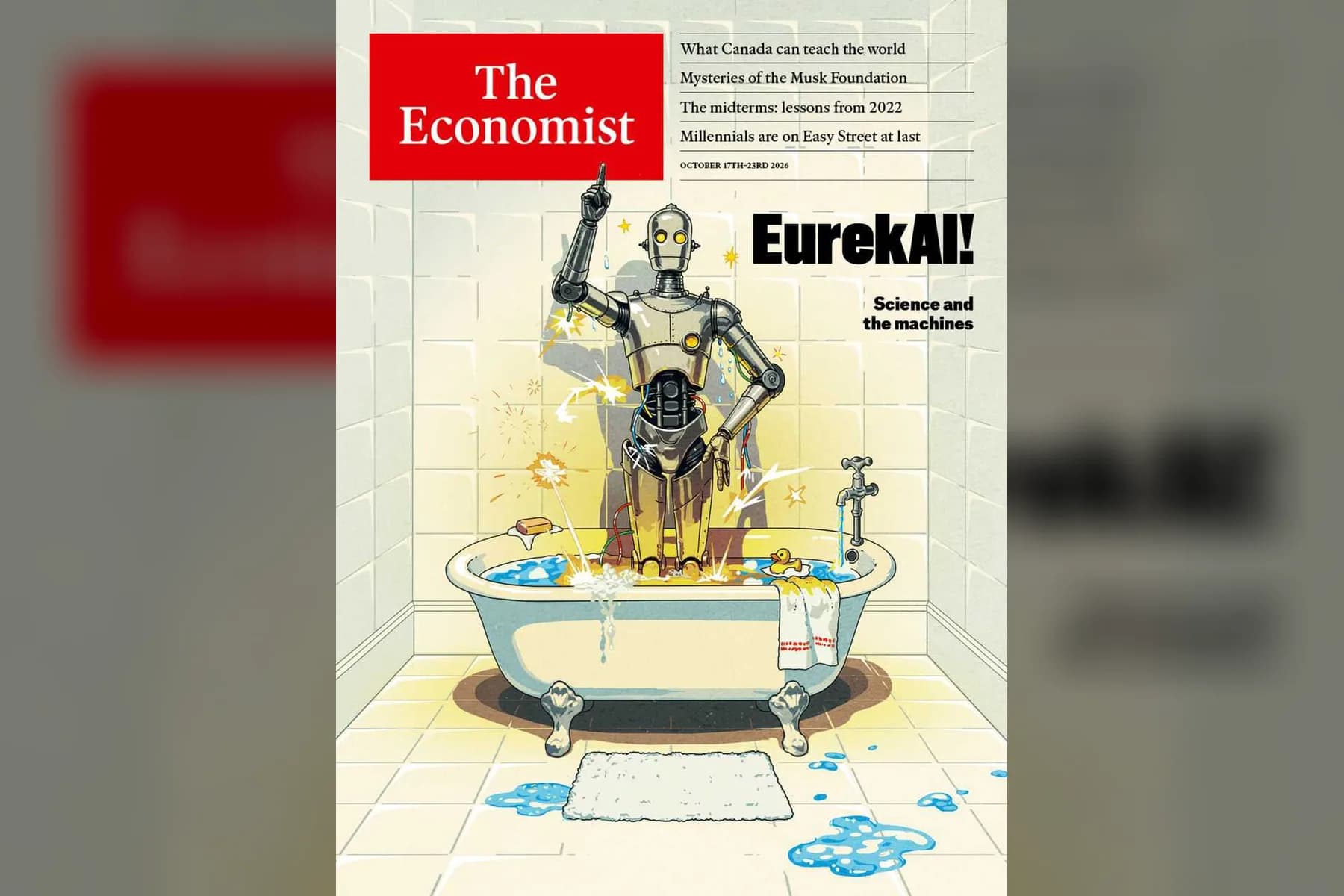
A research paper takes minutes to generate and days to check. In this issue's account of scientific publishing, submissions to the International Conference on Machine Learning doubled to 24,000 between 2025 and 2026. One researcher says he can read only about 100 papers a year closely. The mismatch points to a scarcity that more powerful machines do not automatically relieve: the capacity to decide which results deserve belief.
That problem connects the scientific cover package to an unexpectedly broad range of reporting in The Economist's October 17th issue. Canada needs alternatives it can actually use when America applies pressure. Battery recyclers need waste they can collect, rather than processing capacity on paper. Governments need authority and money to act on climate forecasts. Progress preserves human agency when people retain the knowledge, resources and institutional standing to question a decision and change course. Keeping someone nominally in charge is insufficient if that person cannot understand the evidence, obtain an alternative or make an objection count.
1. Scientific abundance makes verification more valuable
The science leader opens with OpenAI's release of hundreds of mathematical papers claiming advances on long-standing problems. The reporting describes both extraordinary potential and a research community struggling to assess the output. These should remain claims under examination, rather than a tally of independently settled breakthroughs. The interesting question extends beyond how many answers a model produces: can researchers verify them, learn useful methods from them and decide what to investigate next?
Mathematics makes part of that task unusually tractable because a suitably formalised proof can, in principle, be checked mechanically. Empirical sciences also need measurements, experiments and judgments about whether a model represents the world. A correct formal derivation, a convincing explanation and a successful experiment are different achievements. Faster progress in one does not remove the need for the others.
The magazine is right to resist treating established academic careers as a reason to restrict discovery. Researchers do not own the questions they have spent years studying. But their concern about understanding is stronger than a defence of professional status. Methods help people ask new questions and recognise when an apparently successful answer rests on the wrong assumptions. A scientific community that can use a result but cannot interrogate it has acquired a tool while losing some independence.
The biology report makes both the opportunity and the remaining work tangible. Models can propose proteins or genetic changes; experiments must establish what those proposals do. The proposed virtual cells would have to capture interactions, locations and responses across complex biological systems. They remain models, not substitutes for all the evidence needed to establish that a treatment works. The article's more speculative possibilities should therefore be read as a research horizon, rather than an inventory of capabilities already achieved.
AI labs also have a commercial reason to enter science. Problems with verifiable answers offer demanding training tasks for improving their own systems. The reporting raises, without settling, whether specialised scientific advances translate into broader competence. It also identifies a concentration risk: if general frontier models become the dominant research instrument, access to science may increasingly depend on the few organisations able to finance them.
The paperwork article brings this back to institutions. AI can save time on proposals and assist reviewers in finding inconsistencies, while also making polished but unreliable submissions easier to produce. Rewarding publication counts then amplifies the wrong activity. A workable response would give checking, replication, explanation and teaching real career value, alongside discovery. Otherwise the human supervisor remains present but increasingly overwhelmed.
2. Autonomy depends on alternatives that work under pressure
Canada's story supplies the geopolitical counterpart. The leader praises Mark Carney for responding to American pressure with domestic reform and new international relationships. The longer briefing is more qualified: uncertain tariffs themselves discourage investment; some agreements are vague; announcing faster approvals does not establish that projects will be delivered. A favourable political moment creates an opening, rather than a completed economic transformation.
Reducing internal trade barriers and improving investment incentives matter because external bargaining power rests partly on domestic productivity. Finding another customer is harder when a country cannot build the infrastructure needed to reach that customer. Equally, a new diplomatic relationship offers little protection if trade remains overwhelmingly concentrated in the old one. The relevant measure is how many usable choices Canada gains.
The international essay complicates the idea that middle powers can simply join forces. Their interests differ, their geography differs and their dependence on the major powers differs. Canada has resources and relative geographic security that some European and Asian countries lack. Limited coalitions can procure equipment or defend a particular interest without becoming a replacement for every function of the old international order.
Ukraine shows why those limits matter. The issue reports accusations of curtailed American intelligence support and restrictions on Starlink use, alongside the administration's denial that intelligence sharing had stopped. The underlying dependency is clearer than the disputed particulars: European finance cannot immediately reproduce American sensors, satellite services or weapons supplies. Paying for support does not confer control over its continued availability.
The essay also warns that smaller countries can be hurt when great powers reach an accommodation, as well as when they compete. A bargain over fuel, trade or security may leave a dependent third party paying the price. Diversification therefore needs to be tested against specific interruptions: which service could disappear, how quickly could it be replaced, and who controls the replacement? Courage helps countries use their options. It cannot manufacture missing capabilities overnight.
3. Resource security is built through collection and coordination
China's recycling drive shows a more physical route to reducing dependence. The country dominates much mineral processing but still needs imported ores. Recovering metals from discarded products could give it another source. The reporting's most useful detail is that large installed recycling capacity can coexist with too few batteries reaching the right plants.
That gap changes the policy problem. Building another facility does little when used batteries flow to informal dealers or are discarded. Collection networks, product design, responsibility for disposal and traceability all affect how much material is recovered. The article describes digital identification and producer obligations as attempts to connect those stages. Their effectiveness should be judged by actual recovery, costs and environmental performance, rather than the number of registered products alone.
The sulphur report supplies an instructive comparison. A material often treated as a by-product of fuel production becomes a strategic constraint when refinery output and shipping routes are disrupted. Mines and fertiliser makers cannot conjure replacement supplies just because the input was previously cheap. Export restrictions can make the shared shortage worse, while the ability to bear higher costs differs between industries.
Neither story supports complete self-sufficiency. Recycling takes energy and money, and it cannot instantly supply all the material required by a growing economy. Sulphur substitutes and new capacity also take time. The practical objective is to reduce the damage a particular bottleneck can cause. Industrial resilience comes from understanding the whole chain—including collection, transport and customers' ability to pay—before the interruption reveals it.
4. Better forecasts and greener rules need the means to act
The Asian food-shock report distinguishes knowing what may happen from being able to prevent the worst consequences. El Niño arrives on top of expensive energy and fertiliser. Exposure depends both on agriculture and on governments' fiscal room and welfare systems. Farmers facing lower yields and consumers facing higher prices need different forms of help.
The article's strongest proposal is to arrange finance before disaster peaks and release assistance when agreed forecast thresholds are crossed. Its example of a heavily underfunded international appeal shows why prediction alone is inadequate. A warning becomes useful when somebody has the mandate, funds and delivery network to respond. Whether such early action saves money will depend on the event and programme; a headline estimate is no universal guarantee.
African exports expose a related problem at the other end of a regulatory chain. Buyers want evidence of low emissions and deforestation-free production, but small producers may lack affordable ways to supply it. The flower reporting also questions whether air freight alone is an adequate guide to a product's total footprint. Growing conditions and the use of existing passenger services affect the comparison.
The answer is not to discard environmental standards. It is to distinguish a damaging production process from an inability to document a cleaner one. Mapping farms, verifying emissions and sharing compliance costs can determine who remains in the market. A system that rewards credible evidence needs to help smaller participants obtain it, or its administrative demands may overwhelm its environmental distinctions.
Britain's civil-preparedness report offers a particularly sharp version of the same lesson. Emergency plans that businesses and local responders have not seen cannot reliably coordinate those actors. A classified document and a spending category are weak substitutes for rehearsed responsibilities, working communications and funded supplies. Control exists through a chain of people who know what they are expected to do.
5. A number becomes useful when outsiders can challenge it
The AI-finance column questions annualised sales figures, inconsistent revenue definitions and profit measures that exclude major costs. Its criticism does not establish that the technology lacks value. It establishes that rapid growth is difficult to evaluate when the numerator, accounting period and treatment of partners differ between companies. Investors need comparable definitions before impressive figures can answer ordinary questions about returns.
The semiconductor report shows how apparent strength can also redistribute exposure. Concentrated suppliers, advance payments and long contracts may protect manufacturers from part of a downturn while transferring risk to buyers. Those arrangements do not abolish the cycle. They change whose balance sheet absorbs it, and customers may still seek to renegotiate. Measuring industry resilience requires following the obligations as well as the orders.
The data-centre story adds a democratic dimension. The magazine finds a growing association between proximity to sites and support for Democrats. Its matching of polling respondents to nearby facilities is suggestive; it does not by itself prove that construction caused the political shift. Residents' concerns about electricity, water and land use nevertheless deserve answers that can be checked locally. National productivity claims do not settle the distribution of neighbourhood costs.
China's taxation column asks a parallel question about public accounts. More direct and visible collection can strengthen revenue and fairness, while making taxpayers more aware of what they contribute. Better monitoring of citizens does not automatically provide citizens with better oversight of spending. Across these stories, the test of transparency is whether people outside the decision-making organisation can use the information to demand an explanation or correction.
6. Averages need room for people whose experience differs
The issue's reassessment of millennials provides a useful corrective to a familiar narrative. Its comparison across 32 rich countries finds higher inflation-adjusted incomes than earlier generations at the same age in 29 of them, with Italy, Greece and Japan the exceptions. This is a more informative comparison than observing that people earn more as they grow older. It also permits national differences to remain visible.
But a cohort's improving average does not establish that every household has recovered. Housing access, education, family wealth and eventual inheritances can create large differences within a generation. The reported recovery of older millennials' home-ownership rates does not mean younger members face the same conditions. Nor does their experience demonstrate that workers entering an AI-disrupted labour market will follow the same path.
The cultural coverage makes the economic mechanism clearer. Millennials have both spending power and greater authority over which projects get funded. Their nostalgia becomes commercially influential through commissioning decisions, streaming libraries and risk-averse entertainment businesses. Demand and control over distribution reinforce each other. That helps explain a revival without making it evidence that all members of the generation prosper equally.
Japan's contrasting towns provide a useful final qualification. Nanporo attracts families partly because it lies near Sapporo; Yubari faces continuing decline. Local population gains through migration cannot reverse national shrinkage by themselves. For some places, maintaining access to services through a more compact settlement may be a better goal than promising renewed growth. Keeping the ability to change course includes changing the measure of success.
Reservations about this issue
The science package sometimes moves too readily from striking company announcements to language of transformation. Its own reporting supplies the reasons for caution: researchers are still assessing the mathematics, scientific skill may transfer unevenly, and useful biological models require experimental evidence. The case for rewarding verification would be stronger with a more explicit account of who pays for that work, who gets access to proprietary systems and how universities preserve independent research capacity.
The prescription of keeping people in control also needs sharper institutional detail. Which people have authority to stop an experiment or decline an AI recommendation? What expertise and time do they receive? Can junior researchers object without losing their careers? The invited essay by Lawrence Lessig and Yoshua Bengio proposes whistleblower protection, liability and insurance, among other measures. Those are the contributors' proposals, not an established consensus. Insurance in particular requires confronting risks that private markets may be unable to price or cover.
The Canada leader's reform optimism is more confident than parts of the briefing, which raise concerns about selective project approvals, Indigenous consultation and the costs of retaliation. The millennials leader likewise attributes recovery to markets and events more decisively than a cross-country income comparison can establish. Public policy also shapes housing supply, education and labour-market access. A welcome correction to pessimism should not become an equally sweeping claim about what caused improvement.
Four things to watch
- Whether AI scientific claims receive independent checks, accessible methods and funded efforts to explain and reproduce results;
- Whether Canada's investment and diversification plans deliver usable infrastructure and customers, and whether middle-power defence cooperation reduces specific dependencies;
- Whether battery collection and recovery improve alongside capacity, and whether climate finance and compliance assistance reach vulnerable farmers and exporters before losses occur;
- Whether AI companies provide comparable accounts and local data-centre commitments can be verified, while generational comparisons reveal differences within as well as between cohorts.
The issue's strongest shared insight is that greater capability needs a corresponding capacity for judgment. Scientific output, geopolitical agreements and industrial targets become more valuable when people can test them, contest their costs and choose another course. The ability to say no is meaningful when the evidence is accessible and a workable alternative exists. Building those conditions is part of progress itself.
Expressions worth taking away
These ten expressions help discuss verification, dependency, incentives and the distribution of consequences. Each appears in this issue. All example sentences are newly written rather than copied from the magazine.
1. grapple with
Function: Framing a difficult problem
Meaning: To make a serious effort to understand or deal with something complicated.
Universities must grapple with the cost of checking results that machines can produce almost instantly.
Use grapple with a problem/question, rather than treating the phrase as a synonym for an effortless solution.
2. special pleading
Function: Testing an argument's fairness
Meaning: An argument seeking favourable treatment for a particular interest without an adequate general justification; usually critical.
A request for permanent protection becomes special pleading when it exempts one industry from rules applied to everyone else.
Having a personal interest does not by itself invalidate an argument. Explain where the proposed exception lacks justification.
3. in the loop
Function: Participation and oversight
Meaning: Included in the relevant flow of information or decisions.
Keeping a reviewer in the loop is useful only if she has time to examine the evidence.
Keep someone in the loop does not necessarily mean giving that person decision-making power; specify the authority involved.
4. hedge their bets
Function: Managing uncertainty
Meaning: To retain more than one option so that an unfavourable outcome is less damaging.
Manufacturers hedge their bets by qualifying a second supplier before the first one encounters trouble.
Change the possessive to fit the subject: hedge our bets, hedge its bets. It need not refer to financial gambling.
5. at their peril
Function: Warning
Meaning: At the risk of serious adverse consequences; emphatic.
Regulators ignore small exporters' compliance costs at their peril.
Common after verbs such as ignore, dismiss and underestimate. The danger should be explained, rather than left as rhetoric.
6. bear the brunt
Function: Distribution of harm
Meaning: To suffer the main or heaviest part of an adverse impact.
Households without savings bear the brunt of a sudden increase in food prices.
Usually followed by of. It describes a burden, rather than the largest share of a benefit.
7. vested interest
Function: Identifying incentives
Meaning: An established personal or organisational stake in preserving a particular arrangement.
A supplier with a vested interest in exclusive contracts should not be the only source of advice on procurement.
Use a vested interest in with a noun or an -ing form. The phrase warrants scrutiny, not an automatic finding of dishonesty.
8. put paid to
Function: Blocking an expected outcome
Meaning: To end a plan, hope or possibility; an emphatic British idiom.
The missing safety data put paid to plans for an immediate launch.
It suggests an outcome has been decisively blocked, rather than merely delayed by a minor inconvenience.
9. in short order
Function: Describing speed
Meaning: Quickly or within a short time.
The factory can alter its product mix in short order, but replacing its power supply takes years.
Distinguish it from in short supply, which means scarce. A short timetable says nothing about the quality of the result.
10. keep a lid on
Function: Containment
Meaning: To restrain an increase or prevent a problem from escalating; often informal.
Advance contracts may keep a lid on immediate costs while creating obligations that last much longer.
Common with costs, prices and unrest. Containment is not the same as resolving the underlying cause.
Putting the expressions back into an argument
Buyers hedge their bets by approving alternative suppliers, but they still need to grapple with the cost of switching. Keeping an independent engineer in the loop can reveal whether those alternatives really work. Managers ignore that check at their peril, especially when customers would bear the brunt of a failed delivery.
Hedge their bets introduces the precaution, and grapple with identifies the work it still requires. In the loop locates the person able to scrutinise the choice. At their peril warns against bypassing that scrutiny, while bear the brunt identifies those most exposed to failure.
This article was generated by an agent from the October 17th 2026 issue of The Economist.
Conversation
Discussion
Loading responses…