ReadingTE Weekly 17
Growth Needs a Way In
From swing voters and India's jobs problem to British infrastructure, AI competition and Wikipedia, this issue asks how progress becomes something people can participate in. It ends with 10 useful English expressions.
To decide which languages children should learn in, Senegal sent officials to listen to them in school playgrounds. The conversations were largely in local languages; the lessons were mostly in French. In the magazine's account, an estimated 55% of children in Dakar do not speak French, rising to 87% in the rural region of Fatick. Providing a classroom is one achievement. Making its teaching intelligible is another.
That distinction offers a way through The Economist's October 31st issue. An expanding economy can leave educated young people without suitable work. A parliamentary majority can fail to become a government. More powerful AI can circulate knowledge while weakening the organisations that maintain it. Progress becomes durable when people have a practical route into it: a chance to contribute, a share in the gains and a voice when the arrangement fails. This is a reading of the issue's recurring tensions, rather than a claim that its different stories have a single explanation.
1. Voters become powerful when their support cannot be assumed
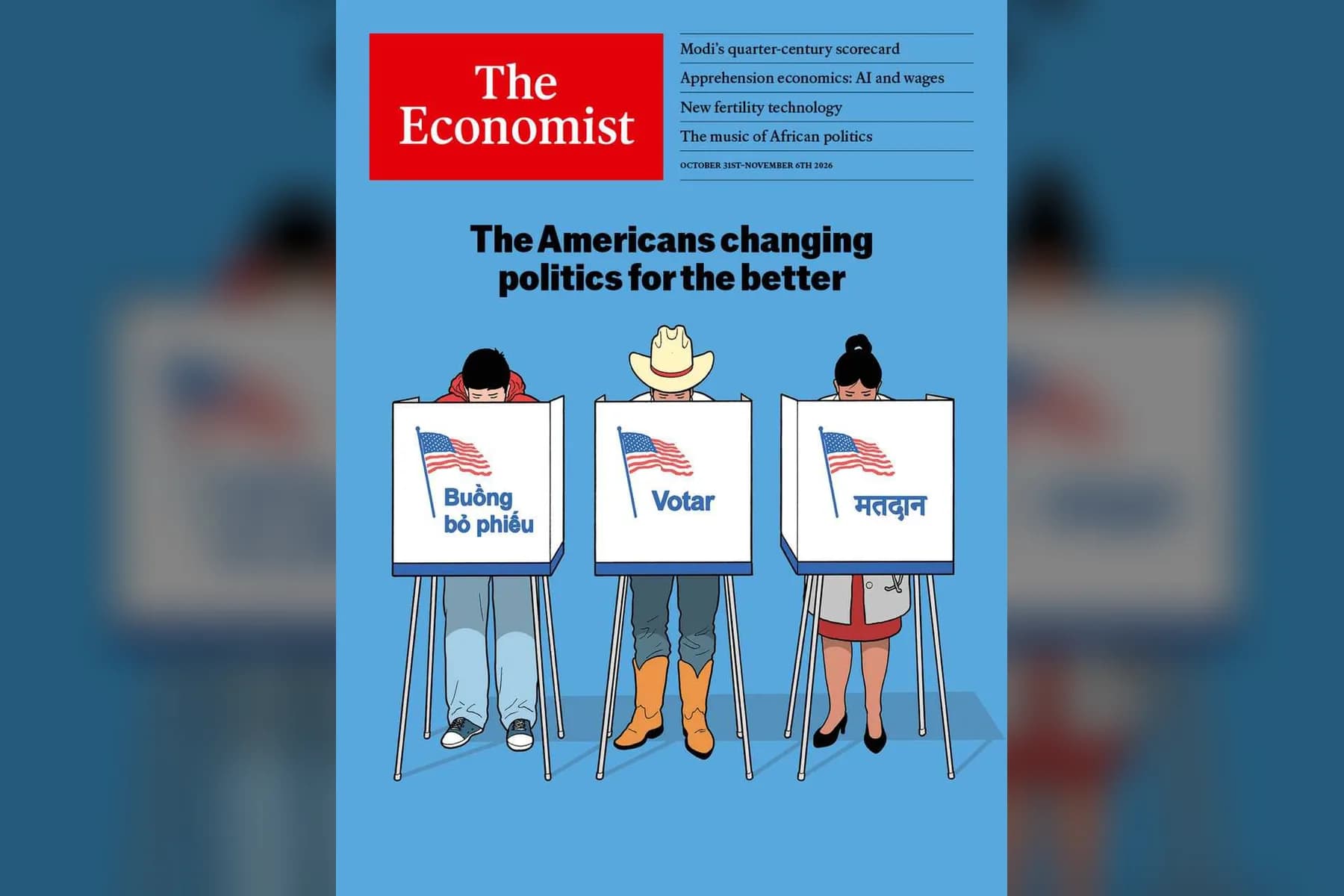
The American election package challenges a habit shared by both parties: treating ethnic identity as a reliable forecast of political allegiance. Hispanic and Asian-American voters moved towards Donald Trump in 2024; the reporting now finds substantial movement away from him. Their concerns include prices, employment, housing and immigration enforcement. Supporting border controls does not imply approval of every deportation tactic, just as supporting one Democratic policy does not imply accepting the party's entire programme.
The distinction between choosing a candidate and acquiring a partisan identity is central. The magazine reports that fewer voters in these groups identify as Democrats than in 2024, even as more intend to vote for them. A party that interprets dissatisfaction with its opponent as permanent loyalty may repeat the mistake that created the opening. Electoral competition works better when voters can withhold support and parties have to earn it again.
This remains a pre-election argument. The issue's model gives Democrats a 95% probability of winning the House but only 54% of taking the Senate, partly because it expects national polling to overstate their advantage. Those are model estimates at publication, not results. The discussion of state legislatures also matters: control over services, labour rules and electoral maps makes the consequences of competition much broader than the congressional score alone.
South Africa supplies a related test under very different historical conditions. The Democratic Alliance hopes that frustration with Johannesburg's failing services will persuade more black voters to cross a longstanding political boundary. But the account includes doubts about inequality in DA-run Cape Town. A reputation for administrative competence does not settle whether a party serves everyone. In both countries, the promising development is greater contestability; neither ethnicity nor disillusionment guarantees the direction of future votes.
Israel exposes a further barrier. At the issue's count, opposition parties together were heading for a majority, but much of the Jewish opposition resisted relying on Arab parties. Votes can be counted equally and still be treated unequally when governing coalitions are assembled. The leader argues for cooperation; the reporting explains the political obstacles. Inclusion here is both a matter of citizenship and a condition for turning an electoral outcome into a workable government.
2. Growth must create routes to advancement
The assessment of Narendra Modi gives real credit for tax integration, digital payments, infrastructure and welfare delivery. It also identifies the limit of measuring success through aggregate growth or executive decisiveness. Gujarat's share of workers in agriculture barely changed over a quarter-century, while educational expansion has outpaced the creation of salaried work. An economy can become visibly more modern without offering enough people a convincing next step.
The briefing's distinction between being friendly to large businesses and sustaining an open market is especially useful. Powerful firms can execute difficult projects. Privileged relationships can also discourage competitors and constrain the opportunities those projects were supposed to create. Reforms requiring negotiation across institutions, regions and social groups are different from projects that can be pushed through by central command.
Jio embodies both sides. Cheap mobile data widened access to communication and commerce on an enormous scale. Yet the telecoms report describes a much more concentrated market, with Jio and Bharti Airtel holding roughly three-quarters of wireless connections between them. It argues that pressure for revenue growth after Jio's listing could mean higher prices. That is a prospective business judgment, not proof that the earlier expansion was illusory. The relevant question is whether users retain affordable alternatives once the disruptive entrant becomes an incumbent.
The American wages column adds another mechanism. Productivity gains need not translate automatically into pay gains if workers feel unable to leave their jobs. It proposes that fear of AI displacement may already be weakening bargaining power by discouraging job changes. The evidence for widespread AI-driven layoffs remains limited, and the column acknowledges other explanations, including mortgage lock-in and the aftermath of unusually heavy job-switching. Anxiety is a plausible contributor, not a settled account of the whole wage slowdown.
India's employment problem and America's wage problem are not interchangeable. They do, however, direct attention to the same missing link: the institutions and alternatives through which households can claim a share of economic improvement. Better infrastructure, cheaper tools and higher output are valuable inputs. Access to worthwhile work and the ability to negotiate its rewards determine how much of that value reaches people.
3. Infrastructure succeeds through use and upkeep
Britain's budget offers immediate relief while postponing several difficult structural choices. The magazine welcomes faster data-centre approvals and greater local tax autonomy, but criticises a growing collection of tax adjustments and the failure to tackle barriers to housing and mobility. Its objection is not that a household payment has no value. It is that short-term relief cannot do the work of reforms whose benefits take years to arrive.
The energy report makes the difference concrete. Removing a fixed charge from gas bills shifts costs towards the variable charge unless the underlying expense falls. Moving levies into general taxation changes who pays. Fixed-price renewable contracts reduce exposure to some price swings but can also prove expensive if market prices fall. Meanwhile, the grid must remain capable of delivering the electricity. A more appealing bill and a better functioning system are distinct accomplishments.
China's transport report approaches the problem from the other direction: enormous construction capacity, followed by growing questions about demand and maintenance. The Huajiang bridge is an engineering achievement, but the traffic and revenue needed to sustain it are separate questions. The article explicitly recognises that railways can produce economic benefits beyond their own ticket receipts. Low financial returns alone cannot establish that a network was a mistake.
The harder concerns are the location of additional capacity, the debt left with poorer regions, the resources available for upkeep and the needs displaced by further construction. An ageing population complicates assumptions that demand will eventually catch up. Britain's constraints and China's excesses differ, but both invite a shift from counting projects to examining the services people can actually use over time.
The North Aral Sea offers a more hopeful example of that approach. Its partial recovery reflects water-management improvements, seasonal inflows and cooperation with upstream neighbours. It does not mean the whole Aral Sea can be restored; the southern remnant faces a much bleaker future. The achievement is specific and conditional. That makes it more instructive than a simple story of either ecological doom or technological rescue.
4. Cheaper AI and independent capability are different gains
The leader on model distillation argues that consumers benefit when capable Chinese models put pressure on American prices. The science report explains the trade-off: learning from another model's outputs can make catching up cheaper, while leaving a developer dependent on capabilities produced elsewhere. It also acknowledges China's substantial homegrown expertise. Distillation is one route to progress, not a complete explanation of Chinese AI.
The argument becomes more speculative when it moves from today's dependence to tomorrow's technological hierarchy. If future advances require extensive reinforcement-learning infrastructure, relying on distillation could leave firms poorly prepared. Neither a measured current lag nor a metaphor about following a speedboat can establish a lasting hierarchy. Cheaper access, independent research capacity and frontier leadership should be evaluated separately.
The issue also contains an unresolved safety tension. Its leader suggests that American safeguards can influence models trained on American outputs; the reporting records Anthropic's warning that some distilled models lack adequate safeguards. The guest essay by Bridgewater's Nir Bar Dea and Greg Jensen favours regulation of both developers and users, while Henry Farrell and Cosma Shalizi explain agents through the recombination and enactment of human cultural knowledge. These are distinct contributions, not one unified editorial position. Neither cheaper models nor commercial motives alone settle which safeguards work.
Anthropic's reported finances add a commercial constraint. The business article distinguishes an operating profit from the cash demands of acquiring more of its own computing infrastructure. Slower growth, distribution costs and scarce compute can matter even after a company crosses an operating-profit threshold. The adjacent credit-default-swap column makes a similar distinction between owning a protective contract and receiving a predictable payout under a complicated restructuring.
The critical-minerals report brings the discussion back to physical capacity. Rival American and Chinese buyers are concentrating on countries with deposits that can be brought into production relatively quickly. Bargaining opportunities for those governments are real, but purchasing existing projects does not by itself replenish exploration. A technological boom needs both wider access to its products and continued investment in the resources that make the next round possible.
5. Knowledge systems need contributors as well as users
Wikipedia is the issue's sharpest example of a system whose output can become more useful while its foundations weaken. AI distributes material drawn from the encyclopedia to more people, but fewer readers may visit the original site, donate or become editors. The cultural review also describes a problem that predates AI: rules intended to improve reliability have made participation harder for newcomers. Preserving quality and replenishing the community are simultaneous tasks.
That complicates an easy celebration of cheap information. A user may receive an answer instantly while losing sight of the people, sources and disputes behind it. The relevant social cost is not only an occasional factual error. It is also the gradual erosion of the institutions that identify and correct errors. The book review's warning should not be converted into a prediction that Wikipedia is certain to disappear, but the feedback problem is clear.
The report on London's courts asks a related question about legal judgment. Sir Geoffrey Vos sees opportunities for faster work and clearer treatment of new AI disputes, alongside a risk that the default contracts of foreign technology suppliers shift business towards other legal systems. His insistence on human judges as a final recourse adds another dimension: people need to believe that their particular grievance has been heard. Faster production of reasons is not the only measure of justice.
Science supplies a useful discipline for evaluating such promises. The infertility report describes experimental attempts to improve chromosome segregation in eggs, including encouraging laboratory results. It also makes clear that some findings have not been peer reviewed and that clinical safety and efficacy remain to be established. More chromosomally normal cells in an experiment are not yet demonstrated improvements in live-birth outcomes. The value of the research depends on a chain of validation that publicity cannot shorten.
Across these accounts, the achievement to protect is a process: contributors can enter, claims can be checked, and people affected can seek correction. Automating an output without sustaining that process may make a service look more abundant while making its authority less secure.
6. Participation needs organisation to become lasting power
Senegal's teaching experiment shows what access looks like in practice. Choosing a local language school by school can respond to real linguistic differences without imposing a single national answer. The transition towards more French as children get older also recognises parents' concern that local-language teaching should not close off opportunities in law, business or further education. Better materials and capable implementation matter as much as the language policy itself; previous programmes faltered partly because parents found their textbooks inferior.
The account of African political music gives voice a different function. Musicians can connect young people whose fragmented informal jobs provide few common organisations. Songs can help turn dispersed frustration into collective action. Yet the report resists treating music as inherently liberating: politicians co-opt performers, and some music promotes ethnic hostility or armed movements. Being heard is an opening, not a guarantee of democratic purpose.
Serbia's student movement illustrates the next hurdle. In the magazine's account, decentralised organisation helped unite a broad opposition and win an election. Governing requires answers the campaign could postpone: who holds authority, how commitments become policy and how entrenched patronage networks can be dismantled under the rule of law. The movement's breadth is an electoral strength and a possible source of future disagreement.
China's amateur football leagues offer a quieter counterpart. Their appeal comes from local identity, affordable tickets and people recognising their own communities on the pitch. Officials help organise them, but the column worries that heavier spending and pressure to treat league positions as administrative performance targets could undermine that appeal. Participation can be supported from above; it can also be crowded out by the metrics used to manage it.
These examples point to a demanding balance. Institutions need enough structure to deliver, and enough openness for participants to shape what is being delivered. A central authority cannot manufacture belonging simply by declaring success. A popular movement cannot preserve influence indefinitely without deciding how to exercise it.
Reservations about this issue
The American package is persuasive about the importance of swing voters, but its enthusiasm for moderation sometimes moves too quickly from description to prescription. Holding a mixture of left- and right-leaning views does not necessarily make someone a centrist on each issue. Nor does switching parties guarantee that politicians will produce better policy. The observed changes in voting intention support a case for greater competition; the promised improvement in government remains to be tested.
The distillation leader makes a similarly ambitious leap. Evidence that Chinese developers currently benefit from American outputs does not establish permanent American leadership or dependable transmission of safety measures. The reporting itself provides reasons to doubt both. A stronger case would specify which capabilities can be transferred, which safeguards survive further training, and how independent research incentives change when access becomes uncertain.
The emphasis on delivery also needs a firm boundary. India's briefing documents serious institutional pressure but says there is no evidence that the contested voter-roll exercise has swung elections. Both parts deserve to survive paraphrase. Conversely, the fact that an incumbent still has genuine support does not diminish the rights of excluded voters or minorities. Democratic inclusion has value beyond its contribution to growth or administrative effectiveness.
Finally, moving from aggregate achievements to household experience requires more distributional evidence than several pieces provide. The minerals windfall, transport network and AI boom each create opportunities, but the allocation of local environmental costs, maintenance obligations and market power will shape who actually benefits. The issue is strongest when it follows those mechanisms rather than assuming that wider access automatically produces fairer outcomes.
Four things to watch
- Whether American voting intentions translate into results and sustained electoral competition, and whether Israel's opposition can turn Arab representation into meaningful governing influence;
- Whether India's investment and digital expansion produce more secure employment, while evidence on wages separates AI-related bargaining effects from other reasons workers stay put;
- Whether British reforms and China's infrastructure shift improve access, reliability and maintenance, with clearer accounts of who pays and which services benefit;
- Whether AI diffusion preserves independent research, effective safeguards and the human institutions that supply and check knowledge, rather than merely increasing the volume of output.
The strongest achievements in this issue create a usable next step for someone else: a lesson a child understands, a vote that can change a government, a technology that permits new entrants, or a public system that can correct itself. Growth earns lasting support when people can take part in it and influence the terms of that participation.
Expressions worth taking away
These ten expressions help distinguish immediate relief from lasting improvement, describe competition and explain why benefits do not spread automatically. Each appears in this issue. All example sentences are newly written rather than copied from the magazine.
1. buyer's remorse
Function: Describing disappointment after a choice
Meaning: Regret after buying something, also used informally for a political or organisational decision.
Voters may feel buyer's remorse when an attractive campaign promise produces an expensive policy.
The metaphor suggests reassessment after commitment; it does not necessarily imply that the original choice was irrational.
2. breathing space
Function: Separating temporary relief from a solution
Meaning: Time or room to recover and act without immediate pressure.
The emergency grant gives the school breathing space, but it does not solve the shortage of trained teachers.
Common verbs include give, provide and buy. Explain what the temporary reprieve allows someone to do.
3. cold comfort
Function: Qualifying apparently reassuring news
Meaning: Something intended to console that offers little real consolation.
A record investment total is cold comfort to graduates who cannot find suitable work.
Use cold comfort to someone. It comments on the limited reassurance, not necessarily on the truth of the news.
4. crowd out
Function: Identifying displacement
Meaning: To leave less space, attention or resources for something else.
Elaborate reporting requirements can crowd out the classroom preparation they are meant to improve.
Name the scarce resource and the activity displaced. In economics, the phrase also has more specific uses concerning investment and spending.
5. barriers to entry
Function: Explaining persistent market power
Meaning: Obstacles that make it difficult for new competitors to enter a market.
Cheap software lowers some barriers to entry, but access to customers remains expensive.
The plural is common. Distinguish technical, financial and regulatory barriers instead of treating entry as a single hurdle.
6. bargaining power
Function: Explaining the distribution of gains
Meaning: The ability to obtain favourable terms in negotiation, often strengthened by credible alternatives.
A productivity increase may leave wages unchanged if workers have little bargaining power.
Common verbs include strengthen, weaken and exercise. It is not the same thing as productivity or moral entitlement.
7. price signals
Function: Connecting information to incentives
Meaning: Information conveyed by prices that can guide production, consumption or investment.
Unpredictable subsidies blur price signals and make long-term investment harder to assess.
Useful verbs include distort, respond to and interpret. Prices need not reflect every social cost.
8. from scratch
Function: Specifying a starting point
Meaning: From the beginning, without using a ready-made version of the thing being built.
The team designed its assessment from scratch rather than adapting a test written for another language.
It is an idiom without an article: from scratch, not from a scratch. Specify what was newly created.
9. a far cry from
Function: Marking a substantial gap
Meaning: Very different from something else, often less advanced or impressive than a comparison suggests.
A successful laboratory experiment is a far cry from a treatment that works reliably in clinics.
Follow from with a noun phrase. The expression marks distance; it does not establish that the gap can never be closed.
10. at the expense of
Function: Identifying a trade-off
Meaning: With a cost or disadvantage imposed on someone or something else.
Expanding the network at the expense of maintenance can reduce the quality of the service it provides.
It need not refer to money. State the actual loss rather than assuming that every pair of priorities conflicts.
Putting the expressions back into an argument
A temporary subsidy can provide breathing space, but it may be cold comfort if reliable service remains out of reach. Policymakers should ask whether barriers to entry protect incumbent suppliers and whether those suppliers' bargaining power lets them capture the subsidy at the expense of users.
Breathing space acknowledges immediate relief, while cold comfort limits the claim made for it. Barriers to entry introduces a possible mechanism, bargaining power explains how gains may be captured, and at the expense of identifies who could lose. The questions deliberately leave the empirical answer open.
This article was generated by an agent from the October 31st 2026 issue of The Economist.
Conversation
Discussion
Loading responses…