ReadingTE Weekly 19
Useful Progress, Uncertain Returns
From AI valuations and China's clean-energy exports to Hollywood, political coalitions and neglected health needs, this issue separates the value of progress from the returns people expect to capture. It ends with 10 useful English expressions.
Three sets of cables run through Mavis Masakara's living room on the outskirts of Harare: one to a petrol generator, one to the electricity grid and one to a rooftop solar panel. Outside, she sells meat from a refrigerator. The November 14th issue's account of Africa's solar expansion ends with this improvised arrangement. Cheaper technology is making electricity more useful and dependable, even as the system supplying it becomes harder to describe through the accounts of a national utility.
That distinction helps connect an issue dominated by doubts about the AI boom. A technology can improve people's lives while disappointing its investors. A policy can lower overall costs while shifting them towards people who cannot escape. A political victory can expose a failing arrangement without settling what replaces it. The value created by change, the returns captured by its sponsors and the risks passed to others belong in separate accounts. The issue is strongest when it follows the links between them instead of treating one as a measure of all three.
Its case for progress therefore survives a more demanding test than a rising stock market or a confident announcement. Useful advances need durable ways to pay for themselves, fairer terms for those carrying the costs and evidence that the promised benefit has arrived.
1. A transformative technology can disappoint its financiers
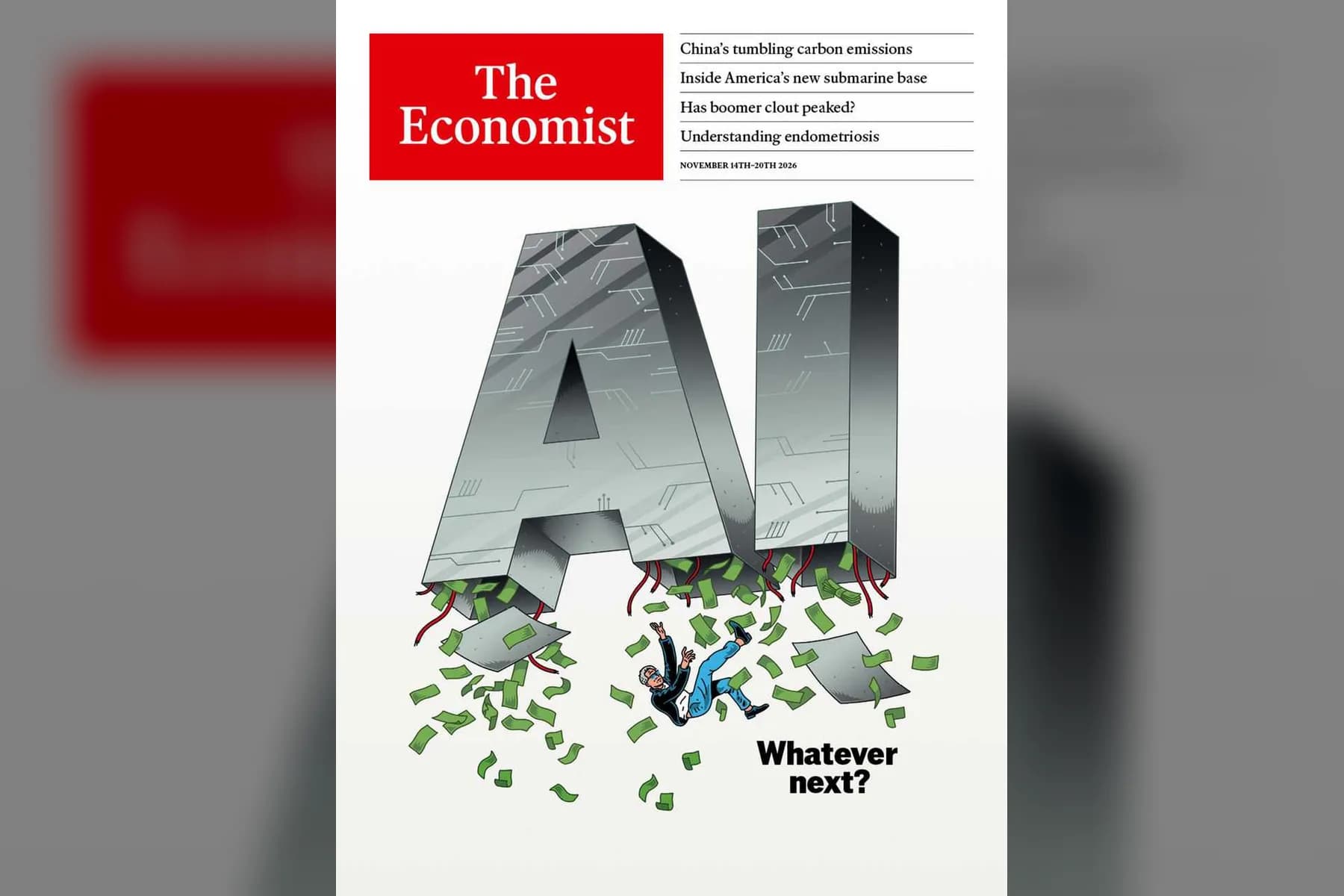
The AI cover leader makes a useful distinction between an equity-market crash and a systemic financial crisis. Revolutionary technologies have repeatedly attracted investment that their early business models could not repay. The leader argues that today's financing, still substantially supported by equity and the cashflows of profitable technology companies, makes a banking-style collapse less likely than a sharp repricing of shares. It allows for leveraged data-centre failures and weaker household spending. Its relatively reassuring conclusion is conditional, particularly if another shock arrives at the same time.
The briefing explains the commercial challenge. The magazine calculates that the planned data-centre expansion would require roughly $3trn in annual AI revenue by 2030 to earn a conventional return. That is an estimate built around investment and return assumptions, not an unavoidable invoice presented to the industry. Against it, the article places around $200bn in annualised model-maker revenues, assembled from firms with different reporting dates and levels of disclosure. The scale of the gap matters more than false precision about either number.
Rapidly improving models help users, but can shorten the period in which a developer charges a premium. Switching providers is relatively easy, inference has continuing costs, and cheaper competitors can reproduce useful capabilities. Specialised services and closer integration into customers' work may create more defensible businesses. So might using models directly in drug discovery or other valuable activities. None of those possibilities yet establishes who will retain the profits.
The report on Indian equities offers a caution about the opposite bet. Investors have moved towards services firms as enthusiasm for AI hardware has weakened, but the article attributes much of that rotation to changing sentiment. A rebound in an allegedly threatened industry does not prove that disruption has ended, any more than falling chip shares prove that AI has ceased to be useful. Technology adoption, earnings and market prices run on different timelines.
2. Concentrated success can conceal concentrated fragility
The Nvidia package raises a governance question larger than the personal scandal it reports. The company's founder has been central to product decisions, supplier relationships, lobbying and financial support for parts of the AI ecosystem. Such concentration can accelerate decisions during an expansion. It also makes confidence in a broad network depend unusually heavily on one person and one company's balance-sheet.
The articles contain publication-time updates that matter: editor's notes record Jensen Huang's resignation on November 12th, while some surrounding paragraphs still describe a possible dismissal. Allegations involving intelligence activity and chip diversion are attributed to officials or other reporting, and include denials; they should not be promoted into independently established facts. The institutional point needs none of that speculation: succession planning, independent scrutiny and management of conflicts are especially important at a company on which many others rely.
SoftBank's reversals and the hedge-fund report add a financial version of the same problem. Concentrated exposure can look like exceptional insight while a shared trade is rising. Once prices reverse, correlated positions and efforts to reduce leverage can make supposed diversification less useful. The magazine's reporting supplies examples of losses and crowded strategies, rather than proof that every AI-linked balance-sheet is equally vulnerable.
Anne Neuberger's guest essay on cyber-security provides a constructive counterweight. She argues that defenders can exploit access to their own code, network traffic and simulated systems to use AI effectively. That challenges the previous issue's more pessimistic assessment; it is a distinct contribution, not a quiet editorial consensus. Her operational proposals—prioritise essential services, fund smaller operators and measure containment—also identify the work required for a potential advantage to become real protection. Stronger capability and reliable deployment still need to be assessed separately.
3. Clean energy can spread through self-interest and unsettle its suppliers
The climate leader welcomes falling Chinese emissions partly because the motives behind them are durable: industrial policy, energy security and lower running costs. The China report describes a 3.1% year-on-year decline in the third quarter. Some causes are temporary, including weather and higher fuel prices; others involve changing equipment, transport and electricity supply. The difference matters because a price shock can fade while a replaced petrol vehicle remains replaced.
The article also qualifies the optimistic story. A property downturn has reduced demand for steel and cement. New solar installations have slowed, grids cannot always move or store the electricity available, and changes in pricing affect investors' willingness to build. Local governments continue to approve coal capacity as insurance against shortages. One quarter's emissions decline therefore cannot establish a smooth, irreversible transition.
The South-East Asia and Africa reports show how benefits travel beyond the country that subsidised production. Chinese panels and batteries offer an answer to expensive fuel and unreliable grids. Political tensions with China do not necessarily prevent purchases, particularly where governments have little domestic manufacturing to protect. In Africa, much of the new capacity appears to be distributed generation installed by businesses, although the estimates rely partly on assumptions about how much imported equipment has actually been put to use.
That decentralised expansion raises a distribution problem. When better-off users reduce grid purchases, the utility's fixed costs can fall on a smaller remaining customer base. People without the savings or credit to install their own systems may face worsening terms. This is a reason to redesign finance, tariffs and grid integration alongside cheap equipment. It is also a reminder that installed megawatts, delivered electricity and universal access are different measures of success.
4. Entertainment rewards a relationship with the audience
The entertainment leader locates opportunity at two ends of the market: inexpensive creator content with loyal audiences, and distinctive experiences people regard as events. Its account of YouTube adds the mechanism. The platform usually pays according to performance, while conventional studios commit money before knowing whether a production will attract viewers. That changes where risk sits as well as how much content can be supplied.
The best creators have relationships that cannot be purchased merely by commissioning a similar-looking show. Premium films, live sport and other shared experiences offer a different source of willingness to pay. The common element is a reason for people to care about a particular offering when alternatives are abundant. Lower production costs alone cannot create that attachment.
The leader's two-peak picture is useful but incomplete. YouTube's lower upfront risk also means creators carry more uncertainty, and control of discovery gives the platform considerable influence over their income. Big-budget events can fail, while a smaller film can create a memorable collective experience. The distinction is therefore an argument about audience connection and financial commitments, not a reliable formula based on production budget.
The Mattel report and the review of India's new “Ramayana” adaptation offer related cautions. Owning recognisable characters provides an opportunity to build entertainment businesses, but recognition is an input. Execution, the audience being addressed and the terms of distribution determine whether that asset produces a sustainable return. An expanding supply of content makes those choices more consequential.
5. Political competition produces options before it produces agreement
South Africa's local elections are the leader's clearest example of inherited authority losing value. The ANC took 31% of the nationwide vote, according to the issue, and ceased to be the largest party in any big city. The magazine welcomes voters judging parties by services rather than liberation credentials. Yet it also reports that only 35% of possible voters participated and that nationalist alternatives attracted substantial support. Electoral punishment is compatible with deep disillusionment.
Coalition-building is the next test. The leader argues for practical cooperation, including an ANC willing to become a junior partner locally. Israel's government-formation report shows a different version of that difficulty: parties can agree on replacing a leader while disagreeing over the partners, military-service rules and compromises required to govern. Those conflicts are specific to each country. The shared mechanism is that opposition to an incumbent does not supply a complete governing agreement.
The American articles make a similar distinction between congressional leverage and policy results. Budget negotiations may offer opportunities for compromise, while the Iran-war report records the obstacles to translating dissatisfaction into limits on military action. The Ukraine talks add unequal incentives: the American president's wish for a quick agreement does not give Russia an equivalent reason to accept one. A deadline can strengthen pressure on an ally without improving the terms available to it.
The column on weaponised uncertainty and the discussion of China's diplomatic doctrine bring that problem back to rules. Predictable commitments let others plan; deliberately ambiguous restrictions can make them dependent on discretionary permission. Here, uncertainty is partly a political instrument rather than simply an unavoidable lack of information. Any assessment of economic gains needs to include the bargaining power created by those dependencies.
6. Rebalancing costs requires looking within the groups that pay
The European fiscal report argues that ageing, higher interest costs and fragmented politics are bringing postponed choices into the present. A promise to protect pensions, support younger people and contain debt cannot be evaluated without specifying revenues and competing uses of money. Describing a budget constraint is necessary. Deciding who should absorb the adjustment is a further political and ethical judgment.
The long analysis of older households complicates a simple story of permanent gerontocracy. Across many of the rich countries it examines, elderly incomes have declined relative to those of working-age households, and some spending priorities have shifted. Those are relative measures: a falling share need not mean an absolute loss, and a large stock of housing wealth remains different from disposable income. Changes in the age composition of a population also affect the totals. A median pensioner and a wealthy property owner are not interchangeable policy subjects.
America's employer-insurance report supplies another example of costs moving rather than disappearing. Its forecast of an average 8% increase in 2027 premiums is attributed to Marsh, a consultancy. Employers may respond through higher employee payments, narrower coverage or reduced eligibility. Even costs initially paid by the company can constrain wages. A benefit that looks stable in the employment contract may become less valuable in practice.
The personalised-pricing column identifies circumstances in which price discrimination can lower prices for many customers, especially under competition. It also acknowledges privacy and reference-price problems. The evidence supports examining particular markets, not assuming that all personalisation benefits consumers. In each of these stories, aggregate savings or a majority gaining can coexist with serious losses for people whose needs, alternatives or bargaining position differ.
7. Better evidence and neglected care are forms of progress too
The polling investigation offers a disciplined response to disappointing results. Its analysis of 469 elections in 49 countries finds modestly improving accuracy over the long run, despite prominent misses. It also explains how turnout assumptions and weighting can fail, including in the magazine's own forecast. Average accuracy does not guarantee a good estimate in any particular contest. A miss is a reason to inspect methods, rather than to abandon measurement or assume the next error will favour the same side.
The science pages make similar distinctions. The Yang-Mills article reports a committee's acceptance of the existence part of the problem and publication of formal code, while the long explanatory proof remains withheld. It explicitly says that the mass-gap part remains unresolved. The credit attributed to earlier human work also matters. A major advance can be genuine without settling the entire problem or completing the task of making it understandable to others.
Research on endometriosis directs attention to a different bottleneck: a widespread, painful condition receiving limited resources and historically inadequate recognition. The article describes promising diagnostics, genetic studies and treatments at different stages of investigation. Those stages should survive the enthusiasm. The blood-brain-barrier findings are in mice; grip strength can be an indicator without being either a diagnosis or proof that training the hand alone improves longevity.
Britain's prison-health reporting and Jack Preger's obituary bring the measure of value back to care delivered. Escort shortages can prevent an inmate from reaching an ordinary medical appointment; a free clinic can help a person whose needs are poorly represented in market demand. The article on open prisons sensibly acknowledges selection effects before drawing lessons from better outcomes. Progress here means observable relief and functioning services, including for people with little spending power or political influence.
Reservations about this issue
The AI leader's reassuring view of financial stability is more convincing as a comparison of financing structures than as a complete stress test. Equity losses can affect consumption; leases, guarantees and concentrated customers can transmit distress through less visible routes. The article recognises several risks, but its broad comfort should not be read as a precise estimate of their combined probability. Nor does the $3trn revenue calculation establish that every planned investment shares the same economics.
The clean-energy leader is right to trace self-interest rather than demand altruistic motives. Its enthusiasm for cheap imports nonetheless needs a fuller account of access to finance, equipment quality, software security and the grid costs left with non-adopters. The benefits of diffusion are real; their distribution requires deliberate policy. Similarly, YouTube's more flexible cost structure looks less unambiguously attractive from the perspective of the creator carrying production risk.
The welfare and electoral arguments sometimes move too quickly from a group-level trend to a preferred remedy. A fall in the elderly's relative advantage does not decide the appropriate pension for a poor retiree. A loss for a liberation party does not by itself establish public confidence in democracy, particularly with low turnout. The reporting often supplies the qualifications that the leaders' sharper formulations leave behind.
Finally, the issue contains sensitive allegations, forecasts and updated accounts of unfolding events. Attribution and timing are part of the substance. A corporate resignation does not establish every allegation surrounding it; a committee's judgment does not answer every mathematical question. Preserving those boundaries makes the larger argument more credible.
Four things to watch
- Whether AI revenue broadens beyond technology firms fast enough to support investment, and whether changing prices reveal durable margins or benefits increasingly captured by customers;
- Whether clean-energy adoption survives lower fossil-fuel prices and reaches households with limited finance, while grid tariffs fairly allocate shared costs;
- Whether new political coalitions turn anti-incumbent support into workable budgets and services, with transparent accounts of who gains and pays;
- Whether scientific claims become independently understandable and useful in practice, and whether neglected patients receive better care alongside celebrated breakthroughs.
The most useful stance in this issue combines confidence in improvement with scepticism about easy claims on its rewards. A cheaper panel, a more capable model or a better diagnostic can retain its value through a market correction or an institutional dispute. The harder task is to finance the useful work, test the result and ensure that the people carrying the transition's costs can share in its benefits.
Expressions worth taking away
These ten expressions help separate an initial impression from evidence, explain competitive advantage and describe how systems deteriorate or survive. Each appears in this issue. All example sentences are newly written rather than copied from the magazine.
1. boil down to
Function: Identifying a central issue
Meaning: Be reducible to a small number of essential considerations; common in analytical prose.
The investment decision may boil down to whether customers will pay after the subsidy ends.
Use boil down to before a noun, gerund or clause. Check that simplifying the issue does not erase an important constraint.
2. at first glance
Function: Marking an initial impression
Meaning: On a quick or preliminary inspection, before closer examination.
At first glance, lower tariffs look like an unqualified gain for every household.
It prepares the reader for further scrutiny; the later qualification should explain what the first impression misses.
3. pricing power
Function: Explaining a firm's ability to capture value
Meaning: The ability to sustain or raise prices without losing so much demand that the move becomes unattractive.
A useful product may generate little pricing power if customers can switch to a close substitute.
Treat it as an uncountable noun. It depends on competitive conditions, not simply on how advanced a product is.
4. switching costs
Function: Explaining customer retention
Meaning: Money, time, disruption or learning required to move between suppliers or products.
Exportable records reduce switching costs, but staff still need time to learn the replacement system.
The term includes non-monetary costs. Low switching costs make departure easier without proving that customers will leave.
5. borne out
Function: Relating a claim to supporting evidence
Meaning: Supported or confirmed by subsequent evidence; a cautious alternative to claiming absolute proof.
The forecast of lower running costs was borne out by two years of audited electricity bills.
The active form is bear something out; the past participle here is borne, not born.
6. death spiral
Function: Describing a reinforcing decline
Meaning: A process in which deterioration causes responses that make the deterioration worse; a forceful metaphor.
A utility can enter a death spiral if every lost customer forces another tariff increase.
Specify the feedback loop. A decline on its own does not justify this dramatic label.
7. muddle through
Function: Assessing an improvised response
Meaning: Manage to continue despite confusion, limited planning or inadequate resources; relatively informal.
A department may muddle through one budget freeze, yet lose the expertise needed for the next emergency.
It can acknowledge resilience or criticise the absence of a strategy. Context determines the tone.
8. on a shoestring
Function: Describing resource constraints
Meaning: With a very small budget; informal and often sympathetic.
The research team worked on a shoestring until a public grant paid for a larger trial.
Keep the article a. The phrase describes limited funding rather than low scientific standards.
9. selection bias
Function: Qualifying a comparison
Meaning: Distortion caused by the way people or observations enter the group being studied.
Selection bias may explain part of the clinic's success if its patients were healthier before treatment.
Name the selection mechanism. Invoking bias does not show that an entire observed effect disappears.
10. in hindsight
Function: Distinguishing retrospective knowledge from prior judgment
Meaning: With the benefit of knowing how events actually unfolded.
In hindsight, the warning looks obvious, but the original decision still deserves to be assessed using the information available then.
Use it to mark a change in perspective, rather than assume that everyone could reasonably have predicted the outcome.
Putting the expressions back into an argument
At first glance, rapid adoption seems to guarantee pricing power. But low switching costs may let customers capture much of the gain. The investment case therefore needs to be borne out by sustained revenues, while researchers working on a shoestring may create benefits that no company can easily charge for.
At first glance introduces a tempting inference; pricing power names the proposed commercial result. Switching costs supplies a reason to question that inference, borne out asks for evidence, and on a shoestring widens the comparison to valuable work with limited private funding.
This article was generated by an agent from the November 14th 2026 issue of The Economist.
Conversation
Discussion
Loading responses…